
TL;DR
- Real SEO services have six named deliverables: technical audit, keyword strategy, on-page work, content, links, and reporting tied to leads. If a proposal doesn't list them, it's incomplete.
- In the Metro Detroit market we typically see ongoing SEO quoted between $800 and $3,000 a month, and one-time technical audit-plus-fix projects between $1,500 and $6,000, depending on site size and competition.
- Most sites show ranking and impression movement inside 60 to 90 days. Actual phone calls and form fills usually land around month four to six.
- Break-even math you can run yourself: annual spend ÷ (average job value × close rate) = leads needed. At $18,000/year, a $2,500 job, and a 10% close rate, that's 72 leads.
- No one can guarantee rankings. Google's own guidance for hiring an SEO says as much, and an agency that won't show you its audit findings before you sign is hiding something.
If you've ever gotten a cold email promising "guaranteed #1 rankings" for $299 a month, you already know this industry has a fluff problem. Real SEO work is auditable. There's a crawl of your site, a keyword map, on-page fixes with dates attached, content built around search intent, links from places that actually exist, and reporting that connects to leads instead of impressions. Anything sold without those pieces named out loud is padding.
Table of Contents
- What do legitimate SEO services actually deliver?
- How much do SEO services cost in Metro Detroit?
- How long does SEO take to show results?
- How do I tell whether my SEO is actually working?
- What does a technical SEO audit check?
- How should I choose between SEO agencies?
- Frequently asked questions
What do legitimate SEO services actually deliver?
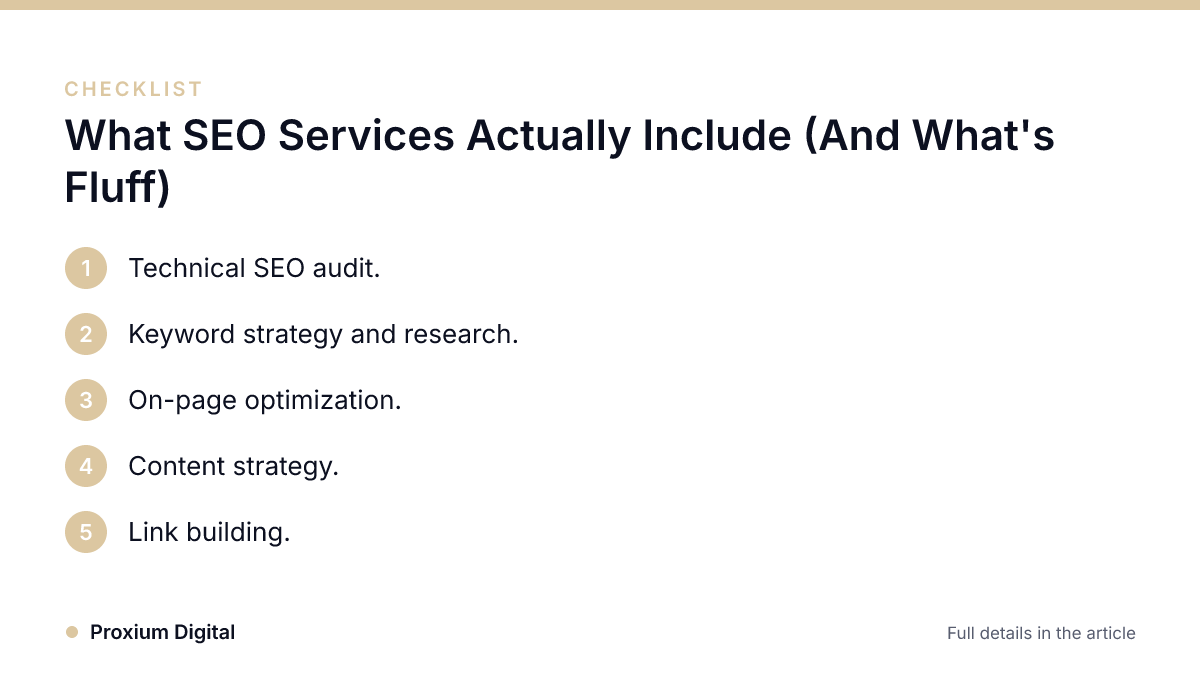
"SEO services" is a catch-all term, which is exactly how weak vendors hide. Here's what should be in scope when someone quotes you a retainer.
Technical SEO audit. The foundation, and skipping it is the most common way an agency burns your first three months. A real audit checks crawlability, mobile load speed, broken links and redirect chains, duplicate content, XML sitemaps, schema, and mobile usability. We walk through the whole process in our technical SEO breakdown. Short version: if your homepage takes six seconds to load on a phone, no amount of blogging fixes your rankings.
Keyword strategy and research. Mapping real search terms, with real volume and buying intent, to specific pages. A dentist in Southfield doesn't need to rank for "dentist." They need "emergency dentist Southfield" and "same day dental crown Southfield." Good strategy also tells you which terms to skip in year one because a national aggregator owns page one and you won't beat it with four blog posts.
On-page optimization. Title tags, meta descriptions, header structure, internal links, and copy that answers the query, tuned page by page. Title tags trip up more sites than people expect, which is why we wrote a full guide on getting title tag length right. Google truncates the long ones and your click-through rate quietly drops even while you're ranking fine.
Content strategy. Not "blog twice a week and hope." Service pages targeting commercial-intent terms, posts that answer specific questions, location pages if you serve multiple cities. Content with no keyword and no intent behind it just dilutes the site.
Link building. Backlinks from relevant, real sites still work as a trust signal. That means local directories, industry publications, chamber listings, and guest content. It does not mean a $50 Fiverr package that gets your domain in trouble two quarters later.
Local SEO and Google Business Profile management. For a local service business this may outrank everything else on the list. Profile optimization, citation consistency (your name, address, and phone matching everywhere), review generation, map pack visibility. When an Ann Arbor or Dearborn business loses map pack position, the cause is almost always one of two things: mismatched citations from an old address, or a profile nobody has touched in a year.
Analytics and reporting. Monthly reporting should show ranking movement, organic traffic, and conversions attributed to organic search. The last one is what most agencies skip. A report that says "impressions up 12%" with no line connecting it to phone calls isn't a report.
Pro tip: Ask any agency to show you a sample technical audit before you sign. If they can't produce one, or it's clearly a template with your domain swapped in, walk.

Two things almost nobody warns you about
Design and SEO can't be separated, even though most companies sell them separately. A gorgeous site built with no SEO input tends to arrive with slow load times, no schema, and a URL structure that's painful to fix later. We covered the usual suspects in common web design mistakes that wreck SEO: uncompressed hero images, JavaScript menus Google can't crawl, that sort of thing. When your web vendor and SEO vendor are different companies, you become the translator every time something breaks.
Maintenance is part of SEO. Rankings aren't a set-and-forget project. Security patches, plugin updates, broken link sweeps, and content refreshes all shape how Google treats your domain over time. A site untouched for two years starts looking abandoned to search engines even when nothing is technically broken. That's why we fold website management into ongoing relationships rather than treating launch day as the finish line.
How much do SEO services cost in Metro Detroit?
The ranges below are what we see in this market, both in our own scoping and in the competing quotes clients bring us. A single-location service business in Livonia chasing a handful of local terms sits at the low end. A multi-location practice in Troy or Birmingham with dozens of service pages across several cities sits near the top.
| Pricing model | Typical range | Best fit |
|---|---|---|
| Monthly retainer | $800–$3,000/mo | Ongoing local SEO, content, and reporting |
| One-time technical audit + fixes | $1,500–$6,000 | Sites with known technical problems or a relaunch coming |
| Project build (new site + SEO foundation) | $4,000–$15,000+ | Businesses starting from a blank page |
| Hourly consulting | $100–$250/hr | Narrow fixes, or a second opinion on a current vendor |
| DIY platform tools | Under $100/mo | Tiny budgets, owner willing to do the work |
Run the math on your own numbers. Say you're quoted $1,500 a month. That's $18,000 over twelve months. Break-even leads = annual spend ÷ (average job value × close rate). With a $2,500 average job and a 10% close rate on organic leads, that's $18,000 ÷ ($2,500 × 0.10) = $18,000 ÷ $250 = 72 leads needed to break even.
Now check whether that's realistic. Nothing meaningful arrives before month four, so you have roughly seven earning months. 72 ÷ 7 = about 10 organic leads a month. If your campaign targets five local terms, each one has to produce two leads a month. For "emergency plumber Livonia," that's plausible. For a term with 40 monthly searches, it isn't, and you should know that before you sign, not in month nine.
The threshold we use: if the keyword set your agency proposes can't mathematically produce your break-even lead count, the problem is the keyword set, not the budget.
Pro tip: Be skeptical of any flat sub-$500 monthly fee promising full-service SEO in a competitive local market. At that price the agency is either running hundreds of accounts through one template or outsourcing yours with no visibility into your market. Our own pricing breakdown shows how we scope by project instead of a single number.
How long does SEO take to show results?
Expect measurable movement (rising impressions, better positions on target terms, cleaner crawl reports) within 60 to 90 days of starting technical and on-page work. Real lead volume usually shows up between month four and month six. A brand-new domain runs longer because Google needs time to crawl, index, and develop any trust in it at all. We get into the specifics in how long SEO actually takes.
| Starting condition | Initial ranking movement | Meaningful lead volume |
|---|---|---|
| Existing site, technical issues fixed | 30–60 days | 3–4 months |
| Existing site, competitive niche (law, medical) | 60–90 days | 6–9 months |
| New site, low-competition market | 60–90 days | 4–6 months |
| New site, competitive Detroit metro market | 90–120 days | 6–12 months |
These are the patterns we see across client accounts, not published benchmarks. Google doesn't put a number on it either, but its guidance on hiring an SEO is direct that results take time and warns you off anyone promising guaranteed rankings fast. Treat that as a filter, not boilerplate.
How do I tell whether my SEO is actually working?
Judge it on the metrics attached to revenue, not total traffic or the number of keywords in a report. What counts depends on your business:
- Local service businesses (plumbing, dental, HVAC, law): Google Business Profile calls and direction requests, map pack position on your top five to ten service terms, and form fills from organic traffic specifically.
- Professional practices: consultation requests sourced from organic, plus rankings on high-intent terms like "[practice area] attorney [city]." Our law firm SEO guide goes deep on that if it's your field.
- E-commerce: revenue from organic sessions and conversion rate by landing page, not session count.
- B2B services: qualified leads from organic, and which pages produce the demo requests.
The leading indicator most owners never learn to read: in Google Search Console, filter your queries to positions 11 through 20. That's page two. Terms climbing into that band are about to matter, because the click curve gets steep between position 10 and position 5. If nothing is moving into that band by month three, the strategy is off even though your traffic chart looks flat and innocent either way.
Pro tip: Have your agency segment GA4 conversions by channel so you can see organic in isolation from paid and referral. If that takes them more than five minutes, they either aren't tracking it or don't want you looking. And cross-check the "calls" number in your Business Profile against your actual phone log. We've seen profiles reporting healthy call volume where half of it was spam.
Rule of thumb: four months into a retainer with no ranking improvement and no lead lift traceable to organic means something is broken. Strategy, execution, or reporting. Find out which.
What does a technical SEO audit check?
A technical audit is a systematic crawl that finds whatever is blocking search engines from indexing and ranking your pages, and it should end in a prioritized fix list rather than a wall of jargon. Here's what gets checked and what each finding means in practice:
- Crawlability and indexing: whether Google can reach the pages you want ranked, and whether the ones you don't (thank-you pages, admin, staging) are properly excluded. A finding like "43 pages blocked by robots.txt" means Google can't see half your site.
- Site speed: mobile load time specifically, since indexing has been mobile-first for years. "Largest Contentful Paint 4.2 seconds" means people are gone before the page finishes.
- Mobile usability: rendering and function on phones, which is where local searches happen. "Tap targets too close together" affects rankings, it's not a cosmetic note.
- Duplicate and thin content: near-identical pages that leave Google guessing which one to rank. "12 pages with duplicate meta descriptions" points you straight at the rewrites.
- Schema markup: structured data describing your business, services, reviews, and location. "No LocalBusiness schema detected" is an easy local win sitting unclaimed.
- Backlink profile health: whether your existing links help or hurt, including anything spammy aimed at your domain.
- Site architecture and internal links: whether your money pages sit within a few clicks of the homepage and whether internal links push authority toward them.
Reading the findings matters more than running the audit. Fix the robots.txt block affecting 43 pages before anyone touches a meta description. If your report is a scored checklist with no ordering by impact, ask for one that ranks by business impact instead.
How should I choose between SEO agencies?
Pick the one that explains its process in plain language, shows you real audit data before you commit, and refuses to guarantee rankings. No legitimate provider can promise placement, only the work that improves your odds. That matches Google's own advice for evaluating SEO professionals, which specifically flags guaranteed-ranking promises as a warning sign.
Practical filters:
- Who owns the accounts? This is the question almost nobody asks and the one that costs people the most. Your Google Business Profile, GA4 property, Search Console, and domain registrar should live under accounts you own, with the agency added as a manager. If they set everything up under their own login, leaving means losing your review history and your analytics baseline.
- Do they own design and SEO in-house? Separate vendors means you play referee every time a change breaks something. Look at how a firm structures SEO optimization services alongside web design services. One roof, one fewer seam.
- Will they audit before you commit? A no-obligation look at your homepage and current visibility tells you how they work before you spend anything.
- Can they name keywords and competitors in your market? If the pitch would fit a business in Ohio just as well as one in Royal Oak, they haven't done the homework.
- Do you get a CMS you can actually use? If you're rebuilding, insist on one you control. Our guide to the best small business CMS options covers what to look for. Updating your holiday hours shouldn't require a developer.
Local knowledge matters more here than people assume. Ranking across Livonia's many distinct neighborhoods is a different problem from ranking in a compact single-market suburb like Birmingham, because searchers use neighborhood names and Google draws map pack radiuses accordingly. Our breakdown of the local SEO landscape in Detroit covers how that shifts city by city.
Next step: if your site looks fine but the phone isn't ringing, get a free homepage and SEO audit before you guess at the cause. You'll leave with a prioritized list of what's broken across technical, content, and design, without committing to a retainer. Get in touch and we'll show you where your site is losing ground.
Frequently asked questions
Do I need a new website before I can start SEO?
Usually no. You can optimize an existing site unless it has structural problems that on-page work can't reach: pages that won't index, no mobile responsiveness, hosting so slow that speed fixes hit a ceiling. Most businesses save real money by fixing the technical issues on what they already have and rebuilding only when the audit proves it's necessary.
Can I do SEO myself instead of hiring an agency?
For a very small budget, yes. Basic on-page fixes, claiming and filling out your Google Business Profile, and building a handful of accurate local citations are all doable solo, and tools like GoDaddy's SEO tools exist for that. The cost is time. You're learning the process while executing it, so results come slower than they would with someone who already made those mistakes on another site.
What happens if I stop paying for SEO services?
Rankings don't disappear overnight. They erode over roughly six to twelve months as competitors keep publishing, building links, and updating while your site sits still. Technical debt creeps back too: plugins go unpatched, content goes stale, links break. That's why plenty of businesses keep a lighter website management plan running after the heavy SEO push wraps.