Law Firm SEO: A Prioritized Guide for 2026

Three things move the needle faster than everything else in law firm SEO: a fully built-out Google Business Profile with active reviews, at least one authoritative practice-area page per target query, and a technically clean website that loads fast on mobile. Get those right before anything else.
Your immediate priority checklist:
- Google Business Profile: Complete every field, choose the most specific primary category (e.g., “Personal Injury Attorney”), upload photos, and set up a review-request workflow this week.
- Practice-area pages: Build one high-converting, answer-first page per core service. Think “Chicago car accident lawyer” not “Our Services.”
- Technical audit: Fix crawl errors, compress images, and confirm your site passes Core Web Vitals on mobile.
- Schema markup: Add LegalService and Attorney structured data so Google and AI systems understand your practice areas.
- Link and PR baseline: Identify three local or legal publications for outreach before month two.
On cost: most law firms pay a few thousand dollars per month for a mid-market SEO retainer, with higher amounts in competitive metro markets such as New York, Los Angeles, and Chicago. Project-based technical audits typically cost several thousand dollars as a one-time fee. The right benchmark for evaluating any of those numbers is a 5:1 revenue-to-cost ratio, meaning every dollar spent on SEO should return five in signed case revenue. If your program cannot clear that bar within 12 months, something needs to change.
Table of Contents
- Why does SEO matter more for law firms than most industries?
- What actually ranks law firms on Google?
- How do you find the right keywords for a law firm?
- What content actually converts for law firms?
- What does a technical SEO audit cover for a law firm site?
- How do you win local SEO for a law firm?
- What link-building tactics actually work for law firms?
- How do you measure whether law firm SEO is working?
- How much does law firm SEO cost?
- What does a 90-day law firm SEO action plan look like?
- What mistakes do law firms make with SEO, and how do you spot a bad vendor?
- Key Takeaways
- The case for building SEO into the site, not bolting it on after
- Proxiumdigital builds law firm websites with SEO already inside them
- Useful sources and tools for ongoing law firm SEO
- FAQ
Why does SEO matter more for law firms than most industries?
A person searching “DUI attorney near me” or “wrongful termination lawyer Detroit” is not browsing. They have a problem, they need help now, and they are going to call one of the first three results they trust. That intent gap between legal searches and most other consumer queries is what makes organic search and the Google Map Pack so valuable for attorneys. The leads are warm before they ever dial.
Paid search in competitive legal markets can cost tens to hundreds of dollars per click for practice areas like personal injury or mass torts. Organic rankings, once earned, deliver that same high-intent traffic without a per-click fee. The 5:1 revenue-to-cost benchmark gives you a clean way to compare: you should aim for each dollar spent on SEO to return about five in signed case revenue to justify the spend. Most competitive markets can hit that within 12–18 months of a well-run program.
The other shift reshaping legal SEO right now is AI. Google’s AI Overviews, ChatGPT, and Perplexity now answer legal questions directly in the search interface. Firms that build authority through named authorship, credible external mentions, and deep practice-area content are the ones getting cited in those AI answers. Firms that publish thin, anonymous blog posts are not. The bar for visibility has risen, and it will not come back down.
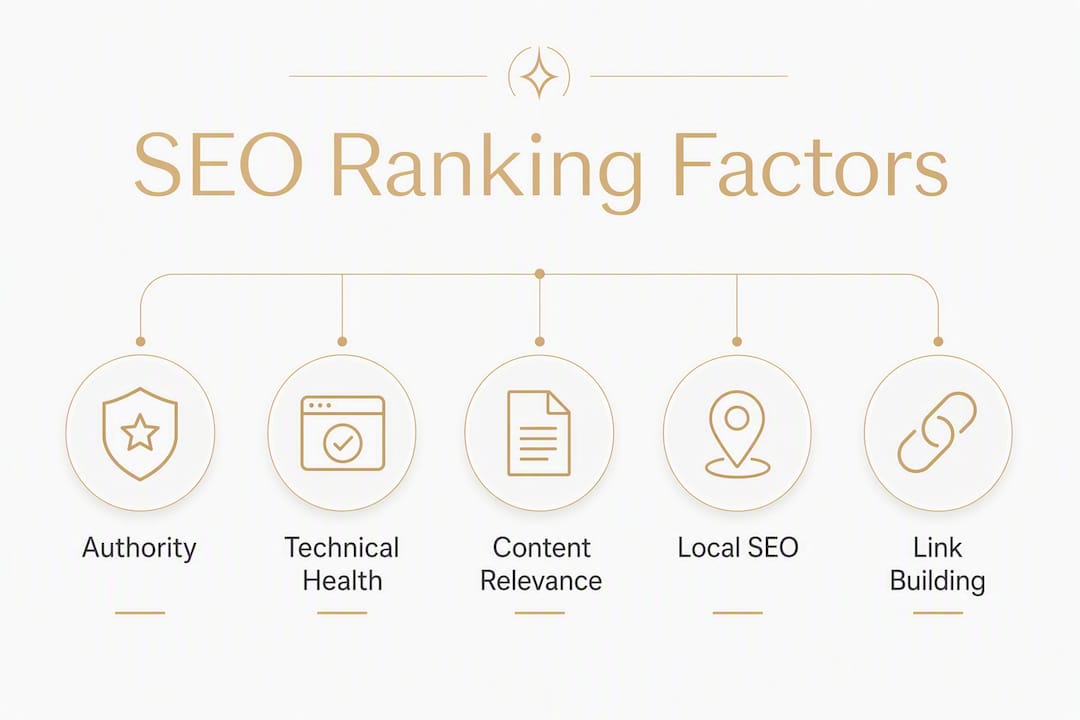
What actually ranks law firms on Google?
Ranking a law firm website is not one problem. It is five overlapping problems: authority signals, technical health, content relevance, local signals, and off-site credibility. Here is how they stack up in practice.
E-E-A-T in plain terms for attorneys
Google’s E-E-A-T framework (Experience, Expertise, Authoritativeness, Trustworthiness) was built with legal content in mind. “Your Money or Your Life” queries, which include any search that could affect someone’s legal standing, get the strictest quality review. What that means for your site:
- Every article and practice-area page needs a named attorney author with a linked bio.
- Bios must list bar admissions, jurisdictions, and verifiable credentials.
- Contact information (address, phone, state bar number) must be consistent and visible.
- Claims about results need to be defensible and compliant with your state bar’s advertising rules.
Technical health: the floor, not the ceiling
| Technical Factor | What to Check | Priority |
|---|---|---|
| Core Web Vitals | LCP under 2.5s, CLS under 0.1, INP under 200ms | High |
| Mobile usability | No horizontal scroll, tap targets ≥ 48px | High |
| HTTPS / security | Valid SSL, no mixed-content warnings | High |
| Crawlability | Clean robots.txt, XML sitemap submitted to Search Console | High |
| Canonical tags | No duplicate pages competing for the same query | Medium |
| LegalService schema | Name, URL, phone, address, areaServed, priceRange fields | Medium |
| Attorney/Person schema | Linked to practice-area pages and bios | Medium |

Schema markup for LegalService and Attorney entities helps both Google and AI systems understand your practice areas, which improves eligibility for rich results and AI citations. It is not optional anymore.
Content relevance and off-site authority
Practice-area pages that match the exact query intent, attorney bios that read like credentials rather than marketing copy, and local landing pages for each office location are the content pillars. Off-site, the signals that move authority are targeted: a quote in a regional legal publication, a feature in a local business journal, or a listing in a respected legal directory like Avvo or Martindale-Hubbell. Mass directory submissions to hundreds of low-quality sites do nothing and can dilute trust signals.
Fix order for the biggest near-term impact:
- Technical errors (crawl blocks, broken pages, missing HTTPS)
- Google Business Profile completeness
- Practice-area page quality and author attribution
- Schema implementation
- Targeted link and PR outreach
How do you find the right keywords for a law firm?
Keyword research for law firms is really intent mapping. Every query a potential client types falls into one of three buckets, and each bucket needs a different page type.
The three intent buckets
- Commercial/transactional: “personal injury attorney Chicago,” “divorce lawyer near me,” “DUI defense attorney Michigan.” These searchers are ready to hire. They need a service page with a clear CTA, trust signals, and a phone number above the fold.
- Local + near-me: “car accident lawyer Detroit,” “estate planning attorney 48201.” These need a localized service page or a location landing page that names the city, courthouse, and relevant local statutes.
- Informational/question-led: “how long does a personal injury case take,” “what is comparative negligence in Michigan,” “do I need a lawyer for a fender bender.” These searchers are researching. They need a well-structured FAQ or guide page that answers the question directly and then offers a consultation.
How to build your keyword list
The best starting point is not a keyword tool. It is your intake transcripts. The exact words clients use when they call or fill out a form are the queries they typed into Google. Pull those phrases first, then expand.
- Review the last 50 intake calls or contact forms for recurring language.
- List the courts, counties, and local jurisdictions your attorneys practice in.
- Add practice-area modifiers: “wrongful termination,” “slip and fall,” “Chapter 7 bankruptcy.”
- Run those seed terms through Google Search Console (if you have existing traffic) and a keyword research tool like Semrush or Ahrefs to find volume and competition data.
- Check the SERP features for each target query: does it show a Map Pack? An AI Overview? A featured snippet? Each feature tells you what content format Google prefers for that query.
Keyword-to-page mapping template:
- High-intent commercial query → dedicated service page (e.g., /personal-injury-attorney-detroit/)
- Local modifier query → location landing page or localized service page
- Question-led query → FAQ page or blog guide with a consultation CTA at the end
- Attorney name query → attorney bio page with full credentials
Pro Tip: Check whether your target queries trigger an AI Overview in Google. If they do, structure your page to lead with a direct, jurisdiction-specific answer in the first two sentences of each subsection. That is the content fragment AI systems are most likely to extract and cite.
What content actually converts for law firms?
The pages that generate consultations share a structure: they answer the question first, establish credibility fast, and make the next step obvious. Here is what that looks like in practice.
Priority content types:
- Localized practice-area pages: One page per service per geography. “Detroit Personal Injury Lawyer” and “Ann Arbor Personal Injury Lawyer” are different pages, not the same page with a city swap.
- Named-author articles: Every piece of content needs an attorney byline with a linked bio. Anonymous content does not build E-E-A-T.
- Attorney bios: Not a paragraph about hobbies. Bar admissions, jurisdictions, notable case types (without violating confidentiality), education, and a professional photo.
- Redacted case studies: “Client rear-ended at a stoplight, suffered a herniated disc, settled for policy limits within 8 months.” No names, no confidential details, real outcomes.
- Procedural FAQ pages: “How long does a Michigan personal injury case take?” answered in two sentences, then expanded with a step-by-step breakdown.
- Intake-focused landing pages: For paid traffic or high-intent organic queries, a stripped-down page with a single CTA, a form, and social proof (reviews, bar admissions, awards).
How to structure a practice-area page for GEO and conversions
A personal injury page that ranks and converts looks like this:
| Section | Content | Purpose |
|---|---|---|
| H1 | “Detroit Personal Injury Lawyer” | Exact-match query signal |
| Opening paragraph | 1–2 sentence direct answer: what you do, where, and what clients can expect | AI citation target + immediate relevance |
| Problem statement | What the client is facing (medical bills, lost wages, insurance pressure) | Emotional connection |
| Short answer / process | 3–4 steps: free consult → investigation → negotiation → resolution | Reduces friction |
| Trust signals | Bar admissions, years in practice, review snippets, awards | Credibility |
| CTA | Phone number + form, above the fold and repeated at the bottom | Conversion |
| FAQ section | 4–6 questions with direct answers | Featured snippet eligibility |
| Author bio | Named attorney with credentials and photo | E-E-A-T |
Pro Tip: For AI visibility, craft the first sentence of each major subsection as a standalone declarative fact: “Michigan’s statute of limitations for personal injury claims is three years from the date of injury.” That sentence structure is what large language models extract and cite. Vague or hedged openers get skipped.
What does a technical SEO audit cover for a law firm site?
Technical SEO is the foundation everything else sits on. A beautifully written practice-area page that cannot be crawled or loads in six seconds on mobile will not rank. Here is what to audit and fix first.
Core technical checklist:
- Core Web Vitals: Run your site through Google PageSpeed Insights. LCP (Largest Contentful Paint) should be under 2.5 seconds. CLS (Cumulative Layout Shift) under 0.1. INP (Interaction to Next Paint) under 200ms.
- Mobile usability: Open Google Search Console → Experience → Mobile Usability. Fix every flagged issue.
- HTTPS: Every page must load over HTTPS with no mixed-content warnings.
- Crawlability: Check robots.txt to confirm you are not accidentally blocking important pages. Submit an XML sitemap to Google Search Console.
- Canonical tags: Every page should declare its canonical URL. Duplicate location pages (same content, different city name) need consolidation or canonical tags pointing to the primary version.
- 404 errors: Fix broken internal links. Redirect deleted pages to the closest live equivalent.
- Page speed: Compress images (use WebP format), defer non-critical JavaScript, and use a CDN.
Pro Tip: Non-technical managers can run a free crawl with Screaming Frog (up to 500 URLs) or Google Search Console’s Coverage report to surface crawl errors, redirect chains, and missing meta tags before briefing a developer. You do not need to understand the code to identify the problems.
Schema implementation step by step
- Add
LegalServiceschema to every practice-area page. Required fields:name,url,telephone,address(withPostalAddress),geo,openingHoursSpecification,areaServed, andpriceRangewhere applicable. - Add
PersonorAttorneyschema to every attorney bio page, linked to the firm’sLegalServiceentity. - Add
LocalBusinessschema to your contact and location pages. - Where you have verified Google reviews, add
aggregateRatingmarkup with accurate counts. - Validate everything with Google’s Rich Results Test before publishing.
Index hygiene
Thin, duplicate location pages are one of the most common law firm SEO mistakes. If you serve 15 cities from one office and created 15 near-identical pages by swapping the city name, Google will likely treat most of them as low-quality. The fix: either write genuinely unique content for each location (local court names, local statutes, local case examples) or consolidate to a single service-area page and use a LocalBusiness schema with areaServed to signal your coverage. For a deeper walkthrough of technical SEO concepts and audit items, the plain-English guide covers what to hand off to a developer.
How do you win local SEO for a law firm?
Local search is the primary conversion channel for most practices. The Map Pack, which appears above organic results for queries like “personal injury lawyer near me,” often drives more phone calls than the organic listings below it. Here is how to earn that placement.

Google Business Profile: the complete setup
Required fields to complete:
- Primary category: Choose the most specific attorney category available (e.g., “Personal Injury Attorney,” not just “Lawyer”).
- Service areas: List every city and county you serve.
- Business hours: Keep them accurate and update for holidays.
- Photos: At minimum, upload your office exterior, interior, and attorney headshots. Profiles with photos receive significantly more direction requests and clicks.
- Services: List each practice area as a service with a short description.
- Google Posts: Publish at least one post per month (a case result, a legal tip, a community event).
- Q&A: Seed your own questions and answers to control the narrative.
Review acquisition workflow
Reviews are a Map Pack ranking signal and a conversion signal. A firm with 80 reviews at 4.8 stars will outperform a firm with 12 reviews at 5.0 stars in most markets.
- Ask at the close of every matter: “Would you be willing to share your experience on Google?”
- Send a follow-up text or email with a direct link to your Google review page within 24 hours.
- Respond to every review, positive or negative, within 48 hours. Responses signal engagement to Google and show prospective clients how you handle feedback.
- Never offer incentives for reviews. That violates Google’s policies and most state bar advertising rules.
Pro Tip: Build your review-request link using Google’s Place ID Finder and shorten it with a redirect on your own domain (e.g., yourlawfirm.com/review). That URL is easy to text, email, or print on a business card.
Citation management
A complete Google Business Profile and consistent citations are essential for Map Pack visibility. NAP (Name, Address, Phone) inconsistencies across directories confuse Google’s local algorithm. Prioritize the top 10 authoritative legal and local business directories first: Google Business Profile, Bing Places, Yelp, Avvo, Martindale-Hubbell, FindLaw, Justia, Super Lawyers, your state bar directory, and your local chamber of commerce. Correct NAP drift at those sources before touching long-tail listings.
Location pages vs. service-area content
Single-office firms that serve multiple cities do not need a separate page for every city. A well-structured service-area section on your site, combined with accurate areaServed schema and a complete Google Business Profile, covers most cases. Build a dedicated location page only when you have a physical office there or when a specific city drives enough search volume to justify unique, substantive content.
What link-building tactics actually work for law firms?
Link building for attorneys is not about volume. One mention in the ABA Journal or a quote in your local newspaper’s legal column does more for your authority than 200 directory submissions. The reason is simple: AI systems and Google’s quality raters look at the same signals a sophisticated client would. If a credible source vouches for your expertise, that vouching carries weight.
Tactics that move the authority needle:
- Legal press commentary: Pitch a short expert comment on a recent court ruling or legislation change to your regional legal publication or bar association newsletter.
- Local news expert quotes: Reporters covering local crime, accidents, or business disputes need attorney sources. Sign up for HARO (Help a Reporter Out) or its successors and respond to legal queries quickly.
- Law school alumni features: Many law school alumni publications feature practitioners. A profile there earns a .edu link and credibility.
- Local organization sponsorships and features: Sponsoring a local nonprofit event often earns a link from a .org domain. The link quality depends on the organization’s authority, not the dollar amount.
- Guest articles in legal trade publications: Write a 600-word practice-area article for a regional bar publication or a legal trade site. Bylined content with a bio link is the cleanest form of attorney-authored authority building.
Pro Tip: When you earn a press mention or expert quote, follow up with the journalist or editor to confirm your firm’s website is linked in the online version. Print mentions without links do not pass SEO authority. A polite follow-up email converts a surprising number of unlinked mentions into linked ones.
Outreach sequence
- Identify 10 target outlets (legal publications, local news sites, bar association blogs, relevant .org sites).
- Research the editor or reporter who covers legal topics at each outlet.
- Craft a pitch that leads with the attorney’s credentials and a specific, timely angle (a new state law, a recent verdict, a consumer protection issue).
- Attach a short bio and a link to the attorney’s bio page.
- Follow up once, seven days later, if no response.
- When a placement is confirmed, add the link to your tracking sheet and note the domain authority and relevance score.
Measure links by relevance and trustworthiness, not raw count. A link from a state bar association page is worth more than 50 links from generic business directories.
How do you measure whether law firm SEO is working?
Vanity metrics, rankings and traffic, tell you what is happening in search. Revenue metrics tell you whether SEO is working as a business investment. Track both, but make decisions based on the revenue side.
Primary KPIs
| KPI | What It Measures | How to Track |
|---|---|---|
| Organic phone calls | High-intent leads from search | Call tracking (CallRail, WhatConverts) |
| Signed matters from organic | Actual revenue attribution | CRM tagging by lead source |
| Cost per signed case (CPA) | Marketing efficiency | Total SEO spend ÷ signed organic cases |
| Average case value | Revenue per client | CRM or billing software |
| Revenue-to-cost ratio | Program ROI | (Signed case revenue) ÷ (SEO spend) |
| Intake conversion rate | Quality of leads | Consultations ÷ signed matters |
| AI citation rate | Generative search visibility | Manual checks + AI monitoring tools |
The 5:1 revenue-to-cost ratio is the benchmark: a firm needs to achieve a revenue roughly five times its SEO spend to consider the program successful. Achieving this within about a year to a year and a half is realistic for most mid-market practices.
Track conversion-focused KPIs like Cost Per Signed Case and intake conversion rate, not just rankings. A firm ranking #1 for a low-intent query that never converts is wasting its SEO budget.
Tracking stack
- Call tracking: CallRail or WhatConverts assigns unique phone numbers to organic, paid, and direct traffic so you can attribute calls by channel.
- Conversion tagging: Google Tag Manager + Google Analytics 4 to track form submissions, chat initiations, and click-to-call events.
- Search Console: Weekly check on impressions, clicks, and average position for target queries.
- AI visibility: Monitor whether ChatGPT, Perplexity, or Google AI Overviews cite your content. Manual spot-checks on your target queries monthly, plus tools like Profound or Otterly.ai for systematic tracking.
Reporting cadence
Monthly reports should cover organic traffic by page, phone calls by source, form submissions by source, and keyword movement for the top 20 target queries. Quarterly reports should add signed matter attribution, CPA calculation, and a content performance review. Any agency that delivers only a ranking report without revenue attribution is not giving you what you need to make decisions.
How much does law firm SEO cost?
Pricing varies more in legal SEO than almost any other industry, because the competitive intensity of markets like personal injury or mass torts is extreme. Here is how to read a proposal without getting misled.
Common pricing models:
- Monthly retainer: The most common model. Covers ongoing content, technical maintenance, link outreach, and reporting. Ranges from $1,500/month for a solo practitioner in a low-competition market to $15,000+/month for a multi-location firm targeting high-CPC practice areas in a major metro.
- Project-based: A one-time technical audit, site migration, or content build. Typically $1,500–$5,000 for an audit; $3,000–$10,000+ for a full site content overhaul.
- Retainer + project hybrid: A common structure for new clients: a one-time onboarding project (audit, technical fixes, initial content builds) followed by a monthly retainer for ongoing work.
- Performance-based add-ons: Some agencies offer a base retainer plus a bonus tied to signed cases or ranking milestones. Evaluate carefully: performance bonuses can create incentives to chase easy wins rather than long-term authority.
What drives price up:
- High-CPC practice areas (personal injury, mass torts, criminal defense)
- Competitive metro markets (New York, Los Angeles, Chicago, Houston)
- Multiple office locations requiring separate local SEO programs
- Significant technical debt on an existing site
- No existing content or a history of thin/penalized content
Red flags in low-cost proposals:
- Promises of specific ranking positions within 30–60 days
- No mention of content strategy or attorney authorship
- Deliverables listed as “X blog posts per month” with no quality or authorship standard
- Opaque reporting with no revenue attribution
For a clear view of what SEO retainers and project packages look like at different price points, the Proxiumdigital pricing page breaks down structures for local professional firms.
Questions to include in every RFP:
- Who writes the content, and will it carry attorney bylines?
- How do you measure and report on signed cases from organic traffic?
- What does your link-building process look like, and can you show examples of placements?
- How do you handle technical issues: do you fix them or just flag them?
- What does month-one deliverables look like, specifically?
When choosing an SEO agency in Michigan, the same questions apply regardless of market: deliverables, attribution, and authorship standards separate serious programs from commodity services.
What does a 90-day law firm SEO action plan look like?
The first 90 days of a law firm SEO program are about building the foundation. Rankings take time, but the work done in months one through three determines whether you see results in month six or month eighteen. Realistic SEO timelines for law firms typically show meaningful organic traffic growth at 6–12 months, with competitive queries taking 12–24 months to fully mature.
Month 1: local presence and technical foundation
- Complete and verify Google Business Profile with all required fields, photos, and services.
- Run a full technical audit (crawl errors, Core Web Vitals, mobile usability, schema gaps).
- Fix critical technical issues: broken pages, missing HTTPS, crawl blocks, and slow load times.
- Build or rewrite two high-intent practice-area pages with named attorney authors and proper schema.
- Audit and correct NAP consistency across the top 10 legal and local directories.
- Set up call tracking and Google Analytics 4 conversion events.
Month 2: content depth and digital PR
- Publish two to three named-author, jurisdiction-specific guides (e.g., “Michigan Comparative Fault Law: What Injury Victims Need to Know”).
- Build out attorney bio pages with full credentials, bar admissions, and professional photos.
- Identify 10 target outlets for digital PR outreach and send the first five pitches.
- Begin a systematic review-request workflow for all closed matters.
- Implement LegalService and Attorney schema across all practice-area and bio pages.
Month 3: measurement, iteration, and link outreach
- Review Search Console data: which pages are gaining impressions? Which queries are close to page one?
- Expand or update the two highest-traffic pages based on actual query data.
- Follow up on PR pitches; confirm links in published pieces.
- Launch systematic link outreach to local organizations and bar association publications.
- Run the first monthly report: organic calls, form submissions, keyword movement, and CPA estimate.
90-day deliverables timeline:
| Week | Deliverable |
|---|---|
| 1–2 | Technical audit complete, GBP fully optimized |
| 3–4 | Critical technical fixes deployed, call tracking live |
| 5–6 | Two practice-area pages published with schema |
| 7–8 | Attorney bios complete, first PR pitches sent |
| 9–10 | Two jurisdiction-specific guides published |
| 11–12 | First monthly report, link outreach active, review workflow running |
Deliverables checklist for briefing an agency:
- Technical audit report with prioritized fix list
- Google Business Profile audit and optimization
- Keyword map (queries to pages)
- Two practice-area page builds with attorney bylines
- Schema implementation across all key pages
- Call tracking and GA4 conversion setup
- Monthly reporting template with revenue attribution
What mistakes do law firms make with SEO, and how do you spot a bad vendor?
The most expensive mistake in law firm SEO is not a technical error. It is hiring the wrong agency and spending 12 months on work that does not compound. Here is what to watch for.
Common tactical mistakes:
- Publishing high-volume thin blog posts with no attorney authorship. Google’s quality raters flag these, and AI systems do not cite them.
- Ignoring local signals entirely and focusing only on organic rankings. Map Pack visibility often converts faster.
- Buying links from link farms or mass-directory services. These can trigger manual penalties that take months to recover from.
- Creating duplicate location pages with swapped city names and no unique content.
- Tracking only rankings, not phone calls or signed cases.
Vendor red flags:
- Guarantees of specific ranking positions. No one can guarantee a Google ranking.
- Opaque monthly reports that show keyword positions but no traffic, no calls, and no revenue attribution.
- Content produced without attorney review or bylines.
- Cookie-cutter deliverables: the same blog topics, the same page templates, the same link sources for every law firm client.
- No mention of E-E-A-T, schema, or local SEO in their proposal.
The single most reliable red flag: an agency that cannot explain how they will attribute signed cases to organic search. If they cannot answer that question in the sales call, they are not measuring what matters. Rankings are an input. Signed cases are the output. Any program that cannot connect the two is flying blind.
Ethics and compliance red flags:
- Content that makes specific promises about case outcomes (“We win 95% of our cases”) without substantiation. Most state bar advertising rules prohibit unverifiable result claims.
- Testimonials that identify clients by name without written consent, or that imply a typical result.
- Case studies that include identifying details about clients without explicit authorization.
- Any content that implies a specialty the attorney is not certified in (in states where “specialist” designations are regulated).
What to require in contracts:
- Ownership of all content and website assets if you leave.
- Monthly reporting with call and form attribution, not just rankings.
- Named deliverables with deadlines, not vague “ongoing optimization.”
- A clear process for attorney review of all published content.
Key Takeaways
Law firm SEO produces its best returns when local presence, authority-first content, and technical reliability are built together from the start, measured against a 5:1 revenue-to-cost ratio.
| Point | Details |
|---|---|
| Local presence first | Complete your Google Business Profile and fix NAP citations before any other SEO work. |
| Authority content wins | Every page needs a named attorney author, jurisdiction-specific facts, and answer-first structure for AI citation. |
| Technical health is the floor | Core Web Vitals, LegalService schema, and crawlability must be resolved before content work compounds. |
| Measure revenue, not rankings | Track organic phone calls, signed matters, and cost per signed case against the 5:1 revenue-to-cost benchmark. |
| Proxiumdigital for integrated builds | Proxiumdigital combines custom website development with SEO baked in from day one, serving law firms and professional practices in Michigan. |
The case for building SEO into the site, not bolting it on after
Most law firms end up in the same situation: a web designer builds the site, then an SEO agency inherits it and spends the first three months fixing what the design broke. Slow load times from uncompressed images, missing schema, thin page templates that cannot support the content depth Google expects, and a URL structure that makes no sense for keyword targeting. The technical debt from a design-first, SEO-second process is real, and it delays results by months.
The firms that move fastest are the ones where the site architecture, URL structure, page templates, and schema are built with search intent in mind from the first wireframe. That means the SEO strategy is set before a single line of code is written. When a practice-area page is designed to accommodate an attorney bio, a FAQ section, a review snippet, and a structured data block, you are not retrofitting. You are building a page that is ready to rank on day one of launch.
The same logic applies to ongoing management. A site that is actively maintained, with security updates, performance monitoring, and content iteration handled by the same team that built it, compounds faster than a site handed off to a client who updates it sporadically. Scope fragmentation between designers and SEO teams is where most law firm digital programs stall.
Pro Tip: When briefing any agency or developer, require a written SEO specification before design begins. It should include the URL structure, target queries per page, schema types, and Core Web Vitals targets. If the agency cannot produce that document, the design and SEO work will conflict.
Proxiumdigital builds law firm websites with SEO already inside them
Most law firms have to choose between a well-designed site and a well-optimized one. Proxiumdigital removes that trade-off. The Michigan-based agency builds custom websites for professional firms with SEO integrated from the architecture stage, so practice-area pages, attorney bios, and local landing pages are structured to rank from launch day, not after a round of fixes.

For a solo or small multi-attorney firm, that means a custom site with the technical foundation, schema, and content templates already in place, plus a monthly SEO retainer that handles keyword targeting, content publishing, and local optimization without requiring a separate vendor. For a growing multi-location practice, Proxiumdigital’s integrated SEO and web design services cover the full stack: site builds, technical audits, monthly retainers, and ongoing website management including security, hosting, and performance reporting.
The practical difference: when the team that built your site also manages your SEO, there is no handoff gap, no conflicting priorities, and no months lost to technical cleanup. If you want to see how the service structure and pricing align with your firm’s size and market, review the package options and reach out for a direct conversation about your practice area and competitive market.
Useful sources and tools for ongoing law firm SEO
Authoritative guides and references:
- DC Bar: Nine SEO Fundamentals for Lawyers — a bar association-vetted overview of keyword research, content, and technical basics for attorneys.
- Clio: SEO for Lawyers — practical guide covering on-site optimization, content strategy, and local SEO for law firms.
- National Law Review: Law Firm SEO for 2026 — authority-first strategy overview with specific guidance on E-E-A-T and AI visibility.
- Fokal: Legal SEO and AI Citation Guide — covers GEO structure, schema implementation, and AI citation mechanics for legal content.
- Attorney at Work: Digital Marketing for Law Firms — KPI frameworks and conversion-focused measurement guidance.
- ABA TechReport — annual survey of technology adoption in law firms, useful for benchmarking digital investment.
- Google Schema.org: LegalService — the primary reference for implementing LegalService structured data.
Monitoring and tracking tools:
- Google Search Console: Free; tracks impressions, clicks, crawl errors, and Core Web Vitals.
- Google PageSpeed Insights: Free; measures Core Web Vitals and provides specific fix recommendations.
- Screaming Frog SEO Spider: Free up to 500 URLs; surfaces crawl errors, redirect chains, and missing meta tags.
- CallRail or WhatConverts: Call tracking with source attribution; essential for connecting organic traffic to phone leads.
- Semrush or Ahrefs: Keyword research, competitor analysis, and backlink monitoring.
- Profound or Otterly.ai: AI citation monitoring for ChatGPT, Perplexity, and Google AI Overviews.
- Google’s Rich Results Test: Validates schema markup before publishing.
FAQ
Does SEO actually work for law firms?
Yes. Law firm SEO produces high-intent leads because people searching for attorneys are typically ready to hire. Organic search and the Google Map Pack consistently deliver qualified consultations, and a well-run program can achieve a 5:1 revenue-to-cost ratio within 12–18 months.
How much does law firm SEO cost?
Most law firms pay a few thousand dollars per month for a mid-market SEO retainer, with higher amounts in competitive metro markets. One-time technical audits generally cost several thousand dollars. Price is driven by market competitiveness, practice area, and number of locations.
Why is local SEO so important for law firms?
Local search produces the most immediate conversions for most practices. Map Pack visibility for queries like “personal injury lawyer near me” drives phone calls from people ready to hire, often faster than high-volume organic rankings for broader informational queries.
How long does law firm SEO take to show results?
Meaningful organic traffic growth typically appears at 6–12 months. Competitive queries in high-CPC practice areas like personal injury or criminal defense can take 12–24 months to reach page one. Local SEO improvements, particularly Google Business Profile optimization, can produce results in 4–8 weeks.
What makes law firm SEO different from general SEO?
Legal queries are classified as “Your Money or Your Life” content by Google, which means they receive stricter quality review. Named attorney authorship, verifiable credentials, bar admissions, and jurisdiction-specific content are required to satisfy E-E-A-T standards. Anonymous or generic content does not rank for competitive legal queries.