Yext vs BrightLocal: Which Platform Should You Choose?

For most small and medium businesses, BrightLocal is the stronger starting point. It offers transparent pricing, owned citations you keep after cancellation, and a local SEO toolkit built around the workflows SMBs actually use. Yext is the right call for multi-location enterprises that need real-time syndication across hundreds of publishers and have the budget for a custom contract. The deciding factors come down to three things:
- Listing ownership vs. rented syndication: BrightLocal builds citations you own; Yext syndicates listings that can revert when your subscription ends.
- Pricing transparency: BrightLocal publishes its plans publicly; Yext requires a custom quote that often surprises SMBs at scale.
- Operational scale: Yext’s real-time publisher network suits 50+ location brands; BrightLocal’s tools suit 1–20 location businesses and agencies managing them, with transparent pricing starting at $39/month for a single location.
If you’re still deciding, run a BrightLocal trial first, then request a Yext demo only if your location count or publisher-sync requirements outgrow what BrightLocal covers.
Key Takeaways
BrightLocal is the right starting point for most SMBs; Yext earns its cost only when real-time multi-location syndication and enterprise API access are genuine requirements.
| Point | Details |
|---|---|
| Listing ownership is the core tradeoff | BrightLocal builds owned citations; Yext syndicates listings that may revert on cancellation. |
| Pricing transparency favors BrightLocal | BrightLocal plans start around $39/month publicly; Yext requires a custom quote that often runs higher. |
| Geo-grid tracking is a BrightLocal advantage | SMBs get granular local rank visibility; Yext’s tracking is oriented toward enterprise reporting. |
| Migration takes two to twelve weeks | Single-location switches run two to six weeks; 20+ locations need eight to twelve weeks plus duplicate cleanup. |
| Proxiumdigital as managed alternative | Proxiumdigital’s managed local SEO covers listings, reviews, and reporting without requiring in-house platform management. |
Table of Contents
- How do Yext and BrightLocal compare side by side?
- How do the platforms actually differ in daily use?
- What should you expect to pay, and how do you evaluate ROI?
- What questions should you ask before buying?
- How do you migrate listings between platforms?
- When does hiring an agency beat using either platform?
- The part most buyers get wrong about this decision
- Proxiumdigital handles local SEO so you don’t have to manage a platform
- Sources
- FAQ
How do Yext and BrightLocal compare side by side?
| Dimension | Yext | BrightLocal |
|---|---|---|
| Best for | Enterprise, multi-location brands | SMBs, local agencies, 1–20 locations |
| Pricing model | Custom quote (enterprise contracts) | Public monthly tiers from ~$39/mo |
| Listing ownership | Rented syndication; listings may revert on cancellation | Owned citations; you keep them after cancellation |
| Publisher footprint | Hundreds of publishers, real-time sync | Major directories + manual/semi-automated citation building |
| Review management | Monitoring, response tools, AI reply drafts | Review generation, monitoring, response workflows |
| Local rank tracking | Basic rank tracking | Geo-grid rank tracking, local search audits |
| Reporting & analytics | Enterprise dashboards, knowledge graph insights | White-label reports, agency-ready dashboards |
| Onboarding & migration | Dedicated account managers (enterprise tier) | Self-serve onboarding, support docs, migration guidance |
| Integrations / API | API-first, CRM integrations, developer access | API available, webhooks, limited native CRM integrations |
Independent comparisons consistently position BrightLocal as the SMB and agency choice, while Yext earns its place at the enterprise tier where real-time publisher sync justifies the cost.
Cost reality check: A single-location SMB on BrightLocal pays roughly $39 per month on publicly available pricing plans. The equivalent Yext engagement is quote-based and typically runs significantly higher, particularly once per-location fees and premium integrations are factored in. At 50 locations, the gap between the two platforms widens considerably, and Yext’s enterprise pricing can reach into four figures monthly depending on the contract scope.
How do the platforms actually differ in daily use?
Listings and data ownership
This is the most consequential difference. Yext operates a knowledge graph that pushes your business data to its publisher network in real time. The speed and breadth are genuine advantages for brands managing dozens of locations. The catch: those listings are syndicated, not owned. Cancel your Yext subscription and the syndicated listings can stop propagating, leaving gaps across directories until you rebuild manually.
BrightLocal takes a different approach. Citation building through BrightLocal creates listings directly on each directory. Those citations stay live after you cancel because you built them, not rented them. For a single-location plumber or law firm, that permanence matters more than real-time sync speed.
Review and reputation management
Both platforms monitor reviews across Google, Yelp, and Facebook. BrightLocal adds review generation workflows, letting you send review request campaigns by email or SMS directly from the platform. Yext’s review tools lean toward monitoring and AI-assisted response drafts, a feature generally suited to brand managers handling volume across many locations rather than a local business trying to generate its first 50 Google reviews.
Rank tracking and local SEO tools
BrightLocal’s geo-grid rank tracking is one of its clearest advantages for SMBs. You can visualize exactly where your business ranks across a geographic grid, spot the specific blocks where a competitor is outranking you, and tie that data to citation or content actions. Yext’s rank tracking is more basic and oriented toward enterprise reporting rather than granular local SEO diagnosis.
BrightLocal also includes local search audits and a citation tracker, giving agencies a full picture of a client’s listing health without needing a separate tool.
Reporting and white-label options
G2 reviewers consistently praise BrightLocal’s white-label reporting as a top reason agencies choose it over alternatives. You can brand reports with your agency’s logo, schedule automated delivery, and present clean dashboards to clients without exposing the underlying tool. Yext’s reporting is powerful but built for internal enterprise use, not reseller workflows.
Support, onboarding, and integrations
Yext assigns dedicated account managers at enterprise tiers, which is useful when you’re coordinating a 200-location rollout. For a five-location HVAC company, that level of support is overkill and often unavailable at lower contract values. G2 reviews for Yext note that smaller accounts sometimes feel underserved, while BrightLocal’s self-serve model and documentation tend to work well for SMBs getting started without a dedicated IT team.
On integrations, Yext leads with an API-first architecture that connects to CRMs, marketing automation platforms, and developer workflows. BrightLocal offers API access and webhooks but is less deeply integrated into enterprise tech stacks.
Pro Tip: To calculate the true cost of any listings platform, multiply the number of fields you update (hours, phone, services, photos) by how often you update them per year, then by the number of locations. That time cost, added to the subscription fee, is your real platform cost. For most SMBs with one to five locations and infrequent updates, BrightLocal’s lower subscription more than offsets any speed advantage Yext offers.
What should you expect to pay, and how do you evaluate ROI?
Pricing models differ fundamentally between the two platforms, and that difference has real budgeting consequences.
BrightLocal publishes its plans publicly. Plans start around $39 per month for a single location, with higher tiers unlocking more locations, white-label reporting, and additional users. You can budget before you ever talk to sales.
Yext does not publish per-location pricing. You request a quote, and the final number depends on your location count, publisher package, and contract length. G2 reviewers frequently flag Yext’s pricing complexity as a friction point, particularly for businesses that want to compare costs before committing to a demo.
Two example calculations:
- Single-location SMB: BrightLocal at ~$39/month = ~$468/year. Yext equivalent: quote-based, but commonly reported as significantly higher for comparable publisher reach.
- 50-location brand: BrightLocal’s per-location pricing scales predictably. Yext at this scale moves into enterprise contract territory where annual fees can reach five figures, though real-time sync and dedicated support are included.
Hidden costs to watch for on either platform:
- Per-location fees that increase your monthly bill as you add locations
- Premium publisher packages (Yext charges separately for certain high-value directories)
- Local landing page hosting or website integration fees
- Onboarding or migration fees for large location counts
- Premium support tiers that unlock faster response times or dedicated managers
Budgeting tip: Before signing any annual contract, ask for a 30-day trial or a pilot on a subset of locations. Run the full workflow, including a test update pushed to publishers, and time how long it takes. That single data point tells you more about operational fit than any sales deck.
What questions should you ask before buying?
Use this checklist when evaluating either platform during a trial or demo.
Must-haves for SMBs:
- Transparent, per-location pricing with no hidden publisher fees
- Owned citations or a clear data-export guarantee on cancellation
- Geo-grid rank tracking or equivalent local visibility reporting
- Review generation and monitoring in a single workflow
- White-label reporting if you’re an agency
Nice-to-haves:
- Native CRM integration or webhook support
- AI-assisted review response drafts
- Local landing page hosting or website embed options
- Dedicated onboarding support
Questions to ask the sales team:
- What happens to my listings if I cancel? Do they revert, stay live, or require manual reclaiming?
- How long does a typical update (address change, new hours) take to propagate to all publishers?
- Which publishers are in your network, and which require a premium package?
- Can I export all my listing data, review history, and rank tracking data at any time?
- Is API access included in my plan, or is it a paid add-on?
- Do you offer white-label reporting, and at which plan tier?
- What does migration support look like, and is there a fee for onboarding existing locations?
Red flags that should pause a purchase:
- Pricing that requires a full demo before any number is shared
- No clear answer on what happens to listings post-cancellation
- Data export limited to certain plan tiers or requiring a support ticket
- Migration support described as “self-serve only” for a large location count
How do you migrate listings between platforms?
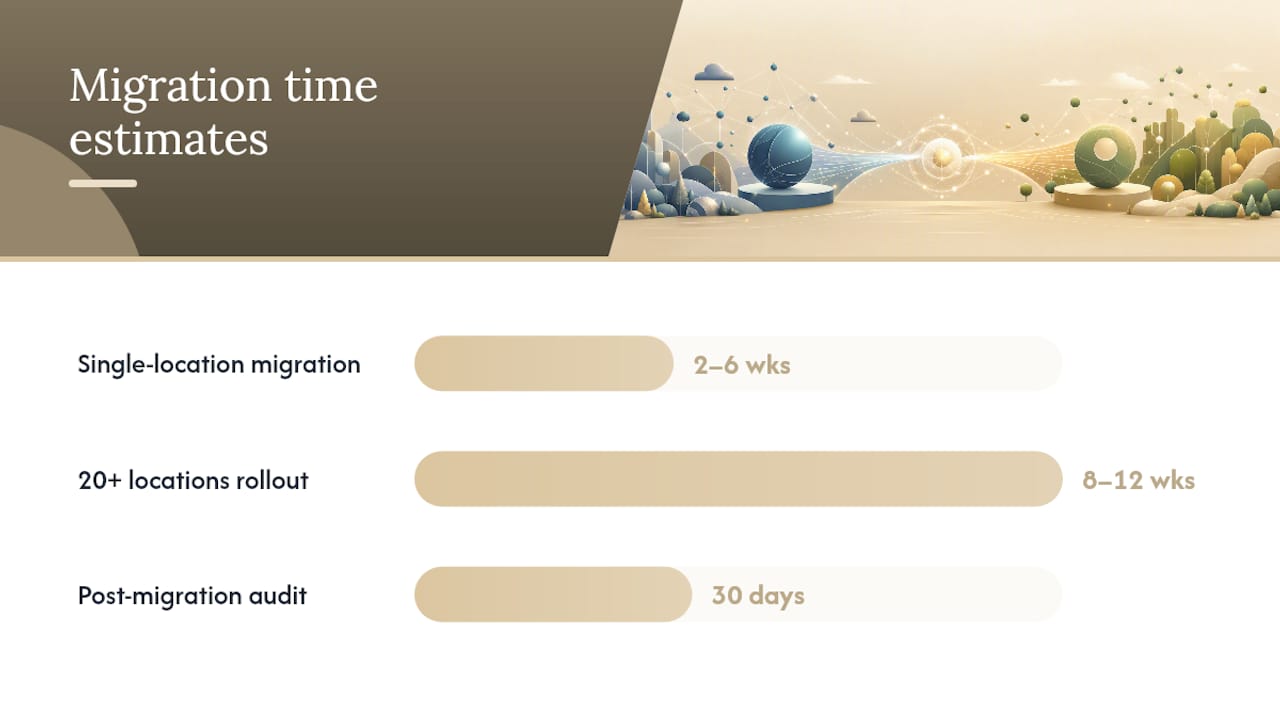
Switching platforms is manageable but rarely instant. Plan for two to six weeks for a single-location migration and eight to twelve weeks for a 20+ location rollout, depending on publisher response times and duplicate cleanup needed.
Migration checklist:
- Export your current data. Pull a full CSV of all business locations, NAP (name, address, phone) data, categories, hours, and any custom attributes before touching anything in the old platform.
- Audit for duplicates. Run a citation audit using BrightLocal’s audit tool or a manual search on major directories. Duplicates left in place will undermine the new platform’s accuracy from day one.
- Claim or request publisher transfers. For Yext-syndicated listings, contact each major publisher directly to claim the listing under your own account. Some publishers automate this; others require manual verification.
- Rebuild or import into the new platform. Upload your cleaned NAP data and let the new platform begin citation building or syndication. Prioritize Google Business Profile, Apple Maps, Bing Places, and Yelp first.
- Update your Google Business Profile independently. GBP is not fully controlled by either platform. Verify it separately and keep it current regardless of which tool you use.
- Audit again at 30 days. Check that updates have propagated and that no old, incorrect listings have resurfaced.
What often fails to port cleanly:
- Review text and review history rarely transfer between platforms. Publishers and review platforms do not provide automated transfer of review content, so your star rating history stays on the directory itself, but any internal platform data is lost.
- Publisher-specific attributes (menu items, service lists, photo galleries) often need to be re-entered manually.
- Local landing pages hosted by Yext do not migrate to BrightLocal. You’ll need to rebuild those pages on your own website or CMS.
If your location count exceeds 20 or your tech stack includes CRM integrations tied to the old platform, hiring an agency or migration specialist is worth the cost. The time saved on duplicate cleanup and publisher coordination alone typically justifies the fee.
When does hiring an agency beat using either platform?
There are situations where buying a SaaS tool and managing it in-house costs more than it saves.
- Single-location businesses with no marketing staff. If no one on your team has time to log in weekly, run audits, and respond to reviews, the platform subscription becomes shelfware. The tool only works if someone works it.
- Multi-location brands that need hands-off operations. At 10+ locations, the coordination overhead of managing listings, reviews, and rank tracking across platforms adds up fast. An agency handles that operationally, not just strategically.
- Businesses that need website and local SEO integrated from the start. A technical SEO foundation built into your site, combined with local landing pages and citation management, outperforms a SaaS tool bolted onto a poorly structured website.
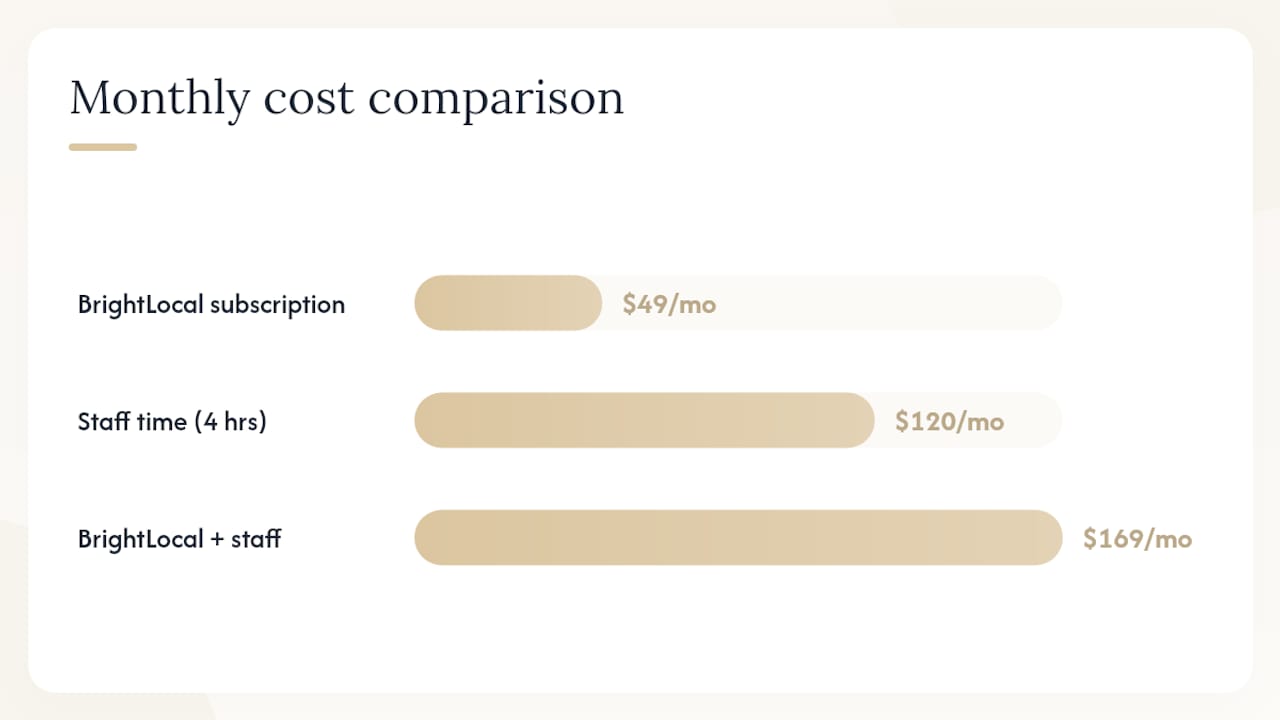
The honest cost comparison: a BrightLocal subscription at $49/month plus four hours of staff time per month at a $30 loaded rate equals roughly $169/month in real cost. A managed agency retainer that covers listings, reviews, rank tracking, and reporting often starts in a comparable range, with the added benefit that the work actually gets done consistently.
Knowing when to hire an agency versus managing SEO in-house is a decision worth making deliberately, not by default.
Pro Tip: Before committing to a platform subscription, calculate your internal hourly cost for the tasks the platform requires. If the platform fee plus staff time exceeds what a managed retainer would cost, the agency option is the financially rational choice, not just the convenient one.
The part most buyers get wrong about this decision
Most people frame the Yext vs BrightLocal decision as a features question. It’s actually a staffing question.
Both platforms work. BrightLocal’s geo-grid tracking is genuinely useful. Yext’s publisher network is genuinely broad. The platform you choose matters less than whether anyone on your team has the time and skill to use it consistently. A BrightLocal subscription sitting unused costs $468 a year and produces zero local SEO improvement. A Yext contract with no internal owner costs far more and produces the same result.
The businesses I see get the most out of these tools are agencies running BrightLocal across a client portfolio, where the per-location economics make sense and the workflow is repeatable. Solo operators and small firms almost always underestimate the ongoing time commitment. They buy the tool, do a solid first month of setup, and then let it drift.
The other mistake: treating listing management as a one-time project. Local SEO optimization is ongoing. Hours change, services expand, new competitors appear in the geo-grid. The businesses that outrank their competitors in local search are the ones updating, monitoring, and adjusting on a regular cadence, not the ones who set up citations in January and checked back in December.
If you have the internal capacity to manage a platform consistently, BrightLocal is the right tool for most SMBs. If you don’t, the honest answer is that a managed service will outperform a neglected subscription every time.
Proxiumdigital handles local SEO so you don’t have to manage a platform
Choosing between Yext and BrightLocal is a real decision with real tradeoffs. But there’s a third option most comparison articles skip: paying an agency to manage the work entirely, so you’re not the one logging in, running audits, and chasing publisher updates.
Proxiumdigital is a Michigan-based SEO and web design agency that handles local listings management, review monitoring, geo-grid rank tracking, and monthly reporting as part of a managed retainer. Unlike a SaaS subscription that requires your time to produce results, Proxiumdigital’s local SEO services are fully managed: we build the citations, monitor the reviews, track the rankings, and report back monthly with what changed and why.
For local service businesses and professional firms that want local search results without the platform overhead, this is the practical alternative. See what’s included in our service packages or check pricing for Metro Detroit businesses to compare the cost against a DIY platform subscription.
Sources
These sources informed this comparison and are worth reviewing directly before making a purchase decision. Vendor documentation and trial accounts will always give you the most current feature and pricing details.
- Yext vs BrightLocal: Compared (2026) | Citation Builder
- BrightLocal vs Yext (2026): Which Tool Wins?
- G2: BrightLocal reviews
Run trials on both platforms before signing an annual contract. Feature lists change; your own workflow test is the most reliable evaluation you can do.
FAQ
Is BrightLocal better than Yext for small businesses?
Yes, for most small businesses. BrightLocal offers transparent public pricing starting around $39/month for a single location, owned citations, and geo-grid rank tracking that directly supports local SEO work at the SMB scale.
What happens to my Yext listings if I cancel?
Syndicated listings pushed through Yext can stop propagating after cancellation, meaning directory entries may revert or go unmanaged. You should claim listings directly on major publishers before canceling to retain them.
Can I switch from Yext to BrightLocal without losing my listings?
Yes, but it requires a planned migration. Export your NAP data, audit for duplicates, claim listings directly on each publisher, and rebuild citations through BrightLocal. Expect two to six weeks for a single location.
Does BrightLocal offer white-label reporting for agencies?
Yes. White-label reporting is one of BrightLocal’s most-cited advantages among agency users, available on higher-tier plans and frequently highlighted in G2 reviews as a top selection driver.
When does Yext make more sense than BrightLocal?
Yext is the stronger choice when you manage 50+ locations, need real-time syndication across a large publisher network, and have the budget for an enterprise contract with dedicated account management and API-first integrations.