Service Business SEO: Map Pack Wins in 60 to 90 Days, Site Integrated

The three activities that move the needle fastest for a service business are a fully optimized Google Business Profile, dedicated service and service-area pages, and an active review pipeline. Google Business Profile improvements can show up in the Local Pack within 60 to 90 days, while organic gains from new service pages usually take 3 to 6 months to mature. Most owners can DIY the profile and reviews; page architecture and technical SEO benefit from professional help once the business has more than two or three services.
TL;DR:
- Optimizing Google Business Profile and reviews can generate visible results in the local pack within 60 to 90 days, with organic page improvements taking 3 to 6 months.
- Service pages tailored to each offering and location, built with quality local details, significantly boost long-term organic rankings beyond initial GBP efforts.
- Building a strong review pipeline and ensuring citation consistency across directories are key to strengthening local trust signals and improving Map Pack rankings.
- Technical factors like page speed, mobile usability, and schema markup shape the maximum potential of all other SEO efforts, requiring ongoing monitoring and optimization.
- Incorporating SEO into website development from the start prevents costly rework and accelerates ranking progress compared to retrofitting existing sites.
Table of Contents
- Why Service Business SEO Works Differently Than Retail or E-Commerce SEO
- The Five Pillars of Service Business SEO
- How to Build a Service Page That Actually Ranks
- Getting the Most Out of Your Google Business Profile
- Reviews, Citations, and Local Links That Build Real Trust
- The Technical Checklist That Quietly Kills Rankings
- How to Sequence Your First Six Months and What to Budget
- Why Building SEO Into the Website Beats Bolting It On Later
- Get Your Service Business Found by the Right Customers
- Sources
- FAQ
Why Service Business SEO Works Differently Than Retail or E-Commerce SEO
Service business SEO isn’t really about traffic volume. It’s about intercepting someone who has a leaking pipe right now, thirty minutes from your shop, and is deciding between three companies in a Google search. That’s a fundamentally different game than ranking a blog post for informational searches.
Local intent dominates almost every query that matters. Someone searching “emergency plumber near me” or “HVAC repair Ann Arbor” has already decided to hire, not to research. That urgency changes how you should think about keywords entirely: a phrase with modest search volume but obvious buying intent (“water heater replacement cost Grand Rapids”) is worth more than a high-volume, vague term (“plumbing tips”) that never converts.
Phone-first behavior shapes the whole strategy too. A large share of service business conversions happen by phone call, not form fill, especially for anything urgent like a broken furnace or a locked-out homeowner. That means:
- Click-to-call buttons need to sit above the fold on mobile, not buried in a footer.
- Your Google Business Profile phone number and website number must match exactly, or you create tracking gaps and trust issues.
- Call tracking software matters more here than in most industries, because a phone call is often the entire conversion event.
The filtering question for every keyword decision is simple: does this term signal someone ready to hire, or someone just browsing? Chase the first kind. Proximity and review signals routinely let smaller local operators outrank bigger competitors with more domain authority, because Google weighs “closest and most trusted” over “biggest website” for these searches.
The Five Pillars of Service Business SEO
Think of these as five separate systems that all feed the same result: more calls and booked jobs. Skipping one weakens the other four, no matter how well-executed they are individually.
- Google Business Profile. This is the highest-leverage lever you have. GBP signals account for roughly 32% of Local Pack ranking weight, which is more than any other single factor. Week one: claim and verify the listing, lock in the primary category, and fill every field completely. Month one to three: build review velocity and post weekly updates.
- Service pages and service-area pages. Every service you offer, and every city or region you serve, deserves its own page rather than a single “Services” page trying to cover everything. This is a slower build (month one to three) but it’s what sustains organic rankings long after GBP work plateaus.
- On-page fundamentals. Title tags, meta descriptions, H1 headings, and FAQ sections that actually answer what a searcher typed. Quick win: rewrite your homepage title tag and top three service page titles this week; they take an hour and often move rankings within weeks.
- Reviews and citations. Review volume and velocity feed Map Pack rankings directly, while citation consistency (your business name, address, and phone number matching everywhere online) prevents Google from distrusting your listing.
- Technical and UX basics. Page speed, mobile layout, and structured data (schema) don’t create rankings by themselves, but they cap how high your other work can climb if they’re broken.
Here’s how to think about which pillar moves which result. GBP and reviews move Map Pack visibility, that three-pack of local results with the map. Service pages, on-page SEO, and technical fixes move standard organic rankings below the map. Most service businesses need both, because the Map Pack captures a big share of clicks but organic listings capture the rest, especially for higher-value or non-emergency services where people compare more before calling.
Pro Tip: If you can only fix one thing this month, fix your Google Business Profile categories. A landscaper listed only under “Landscaper” is invisible to someone searching “lawn aeration service,” but adding that as a secondary service category can surface you for dozens of specific searches you’re currently missing entirely.
DIY versus outsource breaks down cleanly by pillar. GBP setup, review requests, and basic citation cleanup are things any owner or office manager can handle in a few hours a week. Service page architecture, schema markup, and ongoing technical monitoring are where a freelancer or agency earns their fee, because mistakes here (duplicate content across location pages, broken schema, slow-loading images) actively hurt you rather than just underperforming.
How to Build a Service Page That Actually Ranks
A service page isn’t a brochure. It’s a landing page built to answer one specific question: “Can this business do the exact thing I need, near me, at a price I can afford?” Every element on the page should answer part of that question.
The page anatomy that works:
- H1 formula: “[Service] in [City/Region]” — for example, “Furnace Repair in Grand Rapids,” not a clever tagline.
- Title tag: Mirror the H1 closely and add a differentiator, like “Furnace Repair in Grand Rapids | Same-Day Service.”
- Meta description: One sentence naming the service, the area, and a reason to click (licensed, fast response, free estimate).
- Lead paragraph: State what you do, where you do it, and why someone should keep reading, in the first two sentences.
- Process explanation: A short walkthrough of what happens after someone calls, which reduces the anxiety that stops people from picking up the phone.
- Pricing guidance: Even a range builds trust. “$150 to $400 depending on unit age and parts needed” beats no pricing information at all.
- Trust signals: License numbers, insurance mentions, years in business, and real job photos.
- FAQ block with schema: Three to five real questions customers ask, marked up so search engines and AI answer engines can extract them directly.
- CTA: A phone number and a form, both visible without scrolling on mobile.
Best practice puts these pages at 500 words or more of genuinely unique local content, not padding. That word count matters less as a target to hit and more as a signal: pages that thin usually skip the process explanation, pricing guidance, or trust elements that actually convert.
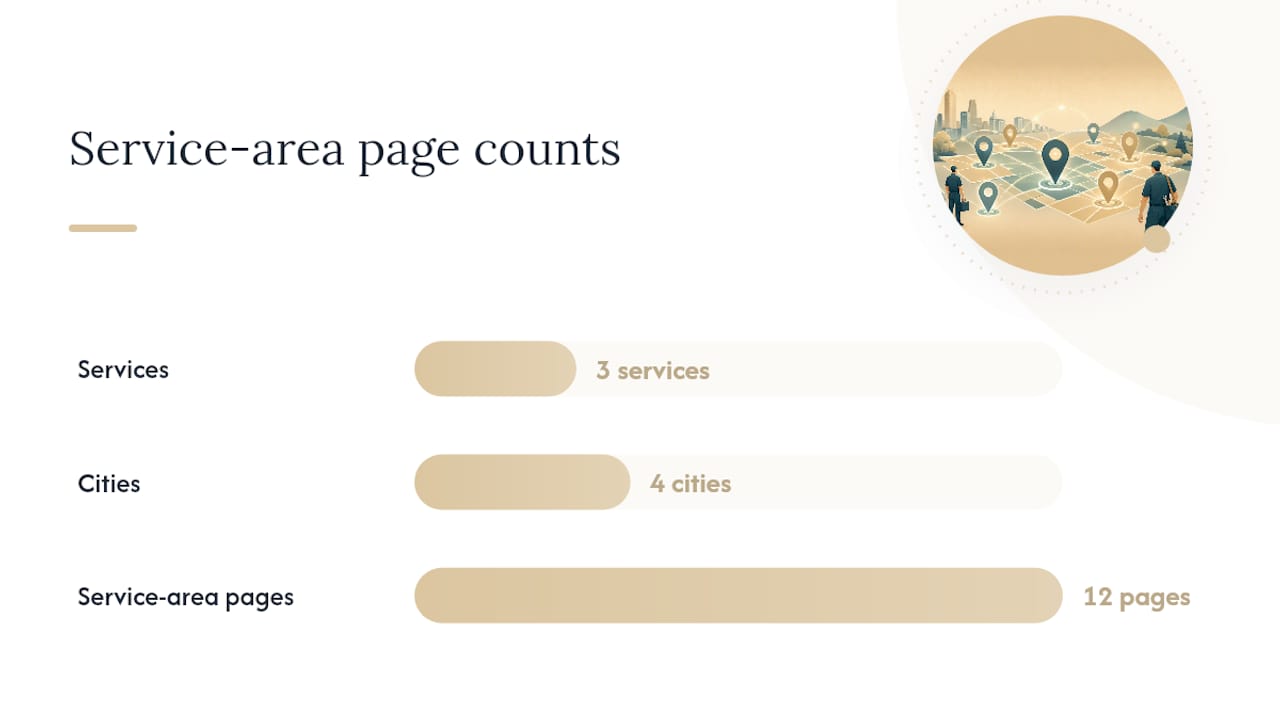
The harder question is how to build service-area pages, one per city or neighborhood you serve, without duplicating content and getting penalized for it. The fix is to build each page around real local specifics rather than swapping the town name into a template. Mention actual neighborhoods, local building types common in that area, response-time realities for that specific drive, or a completed job you did nearby. A services × locations matrix, say three services across four cities, gives you twelve pages, but only if each one earns its place with distinct detail. Twelve thin pages with swapped town names will underperform three strong ones.
If you run more than a handful of service areas, structuring a multi-location page system becomes its own project worth planning deliberately rather than bolting on ad hoc.
Getting the Most Out of Your Google Business Profile
Your Google Business Profile is doing more ranking work than your website, at least in the early months, so treat it as a living asset rather than a one-time setup task.
- Lock in your primary category first. Choose the single most accurate category (not the broadest one) since it carries more ranking weight than secondary categories. Add every relevant secondary category afterward.
- Define your service area precisely. List the actual cities or zip codes you serve rather than a wide radius that includes areas you don’t really want to work in.
- List every individual service, not just categories. “Drain cleaning,” “water heater installation,” and “leak detection” as separate service line items help you surface for each specific search.
- Upload real photos regularly. Job-site photos, your team, your vehicles, and completed work outperform stock images and signal an active, real business.
- Post weekly. GBP posts about promotions, completed jobs, or seasonal reminders keep the profile active, which Google reads as a signal of legitimacy.
Review workflow matters as much as the profile setup. Ask for the review within 24 to 48 hours of completing the job, while the experience is fresh, using whichever channel gets the highest response rate for your customers, usually a text message with a direct link rather than an email that sits unread. A realistic cadence to aim for is roughly two reviews per week, which puts you around 50 reviews over a year, a level that starts to separate you from competitors still sitting at a dozen.
Pro Tip: Train your team to ask customers a specific question when requesting reviews: “Would you mind mentioning the type of work we did in your review?” A review that says “fixed our AC unit quickly” carries more keyword relevance than “great service,” and it reads more convincingly to the next customer too.
Once the profile is running, watch three metrics monthly: GBP actions (calls, direction requests, and website clicks from the listing itself), your position in Map Pack results for your core service terms, and review count alongside average rating. A profile with rising calls but flat website clicks usually means people trust you enough to call directly, which is a good problem to have.
Reviews, Citations, and Local Links That Build Real Trust
Citation consistency sounds tedious, and it is, but it’s foundational. If your business name, address, and phone number are formatted differently across Yelp, the Better Business Bureau, and your own website, you’re actively confusing the trust signals Google uses to verify you’re a legitimate, single business. Start a citation audit with your top ten most-visited directories for your industry, correct any mismatches, and then let the smaller ones follow.
Local link building for a service business doesn’t need to look like a content marketing campaign. It needs to look like normal business activity that happens to generate links:
- Sponsor a local youth sports team or community event; most will link to your site from their sponsor page.
- Pitch a local reporter on a seasonal angle (first-freeze plumbing tips, spring HVAC checklists) tied to your expertise.
- Trade links with complementary trades you already refer work to, a roofer and a gutter company, an electrician and an HVAC contractor.
Local links from reputable local sources carry more weight for map rankings than dozens of generic directory submissions, so prioritize quality over quantity here. Reviews double as informal link and citation signals too, since review platforms themselves are often high-authority domains that reinforce your local relevance every time someone leaves feedback.
The Technical Checklist That Quietly Kills Rankings
Most technical SEO problems for service businesses aren’t dramatic. They’re small, invisible drags that cap how well your GBP and service page work can perform.
- Page speed. Compress images before uploading (most CMS platforms don’t do this automatically), enable browser caching, and choose hosting built for speed rather than the cheapest available plan.
- Mobile layout. Since most service searches happen on a phone, your click-to-call button needs to be visible without scrolling, and contact forms should ask for name, phone, and a one-line job description, nothing more.
- Schema markup. Add LocalBusiness schema sitewide, Service schema on each service page, and FAQPage schema on any page with a question-and-answer section, since this structured data helps both traditional search results and AI-driven answer engines pull your business into direct answers.
Structured data implementation is one of the few technical items worth getting right from day one rather than retrofitting later, since retrofitting schema across dozens of service pages takes far longer than building it in from the start.
How to Sequence Your First Six Months and What to Budget
A realistic six-month plan looks roughly like this. Months zero to three: complete and optimize your Google Business Profile, launch the review request workflow, fix your top three technical issues, and publish your core service pages. Expect Map Pack movement in this window. Months three to six: build out service-area pages, clean up citations, and start local link outreach. Expect organic ranking gains to compound here as content and authority accumulate.
- DIY approach: Realistic for GBP management and review requests, roughly 3 to 5 hours a week, no direct cost beyond your time.
- Freelancer or part-time help: Reasonable for service page copywriting and basic technical fixes if you have more services than time.
- Agency retainer: Makes sense once you’re managing multiple services and locations. Retainers in the $800 to $1,500 per month range are common for honest, focused local SEO work, with higher-competition markets or multi-location campaigns costing more.
When you’re evaluating a proposal, ask for specific milestones tied to timeframes (not vague promises), a monthly reporting structure that shows GBP actions and organic leads separately, and a clear list of deliverables rather than a bundled “SEO package” with no itemization.
Why Building SEO Into the Website Beats Bolting It On Later
Most service businesses hire a web designer first, launch a site, and only think about SEO months later once leads don’t materialize. That sequence creates rework: retrofitting schema, rebuilding page structure, fixing speed problems baked in by a template that was never built with search in mind.

Proxiumdigital takes the opposite approach, building SEO into the site from the first line of code rather than treating it as an add-on. That means faster load times from the start, because performance decisions get made during development instead of patched afterward, and it means service pages launch with the structure, schema, and local detail this article just walked through already in place.
The practical effect is fewer redo cycles. A business that launches a site built this way isn’t waiting for a second project to fix what the first one missed; the methodology is designed so the optimization work and the build happen as one continuous process, which shortens the distance between launch and the kind of ranking movement covered above.
— Bryan
Get Your Service Business Found by the Right Customers
Proxiumdigital is the alternative to hiring a web designer and an SEO agency separately, then hoping their work lines up. For Michigan service businesses, that means one team building your site and your search visibility as a single project instead of two disconnected ones, so the Google Business Profile work, service page architecture, and technical fixes covered in this guide get built in from day one rather than patched in later.

A typical engagement starts with an audit of your current site and GBP presence, moves into prioritized fixes ranked by impact (usually GBP and service pages first, technical cleanup running alongside), and continues with monthly reporting so you can see calls, organic leads, and ranking movement rather than guessing whether the work is paying off. Clients focused on local service categories often see Map Pack movement within that first 60 to 90 day window this article outlined, with organic gains building through month six.
If you’re ready to see what a prioritized plan looks like for your specific services and area, explore Proxiumdigital’s SEO optimization services and request an audit to find out where your fastest wins are hiding.
Sources
FAQ
Is SEO Dead Now That AI Answers Search Queries?
No. AI-driven search actually raises the value of structured, factual content like clear service pages and schema markup, since AI systems pull answers from well-organized local business data rather than replacing the need for it.
How Much Should a Service Business Pay for SEO?
Honest local SEO work commonly runs $800 to $1,500 per month for a single-location business, with multi-location or highly competitive markets costing more depending on scope.
Is SEO Still Worth It for a Small Service Business?
Yes, especially because proximity and review signals let smaller businesses outrank larger competitors in the Map Pack despite lower domain authority, provided the Google Business Profile and reviews are actively managed.
Can a Business Owner Handle SEO Without Hiring Help?
Yes, for Google Business Profile management, review requests, and basic citation cleanup, which most owners can run in a few hours weekly. Service page architecture, schema, and multi-location structuring usually benefit from professional support like Proxiumdigital’s integrated approach.