Near Me SEO: A Practical Guide for Local Businesses

Claim your Google Business Profile, confirm your NAP is consistent everywhere, build location pages with city and service keywords, add LocalBusiness schema with accurate hours, collect Google reviews weekly, pass a mobile speed check, earn a handful of local citations and backlinks, then track everything in GBP Insights and Google Search Console. Those eight actions, done in that order, drive the majority of “near me” visibility gains for U.S. local businesses. Local search optimization is the discipline behind all of it, and the steps below show exactly how to execute each one.
Prioritized checklist:
For business owners (do these first, this week):
- Claim and verify your Google Business Profile at business.google.com
- Audit your name, address, and phone number (NAP) across your website, GBP, and top directories
- Add or update your primary service categories, business hours, and at least 10 photos in GBP
For marketing teams (do these in month 1): 4. Build or refresh one location page per city you serve, targeting city + service keyword clusters 5. Deploy LocalBusiness JSON-LD schema with hours and geo coordinates on every location page 6. Launch a review-request workflow: direct link, follow-up timing, and a response template for negative reviews
For outsourcing (month 2 and beyond): 7. Build local citations in primary directories and pursue three to five local backlinks (press, chamber, sponsors) 8. Set up call and direction tracking in GBP, connect Google Search Console to your location pages, and run monthly rank snapshots

Pro Tip: Never paste “near me” into your title tags, H1s, or meta descriptions. Google resolves proximity from device GPS, not from the phrase on your page. Stuffing “near me” into copy reads as spam to both Google and real visitors.

Table of Contents
- How does Google rank “near me” searches?
- Step-by-step implementation: GBP, on-page, reviews, citations, and measurement
- How should multi-location and service-area businesses set up their listings?
- What results should you expect, and what does it cost?
- How Proxiumdigital implements “near me” SEO for local clients
- Key Takeaways
- The part most guides won’t say out loud
- Proxiumdigital’s local SEO services for Michigan businesses
- Useful sources
- FAQ
How does Google rank “near me” searches?
Google’s local algorithm runs on three factors: Relevance, Distance, and Prominence. Understanding what each one actually controls tells you where to spend your time.
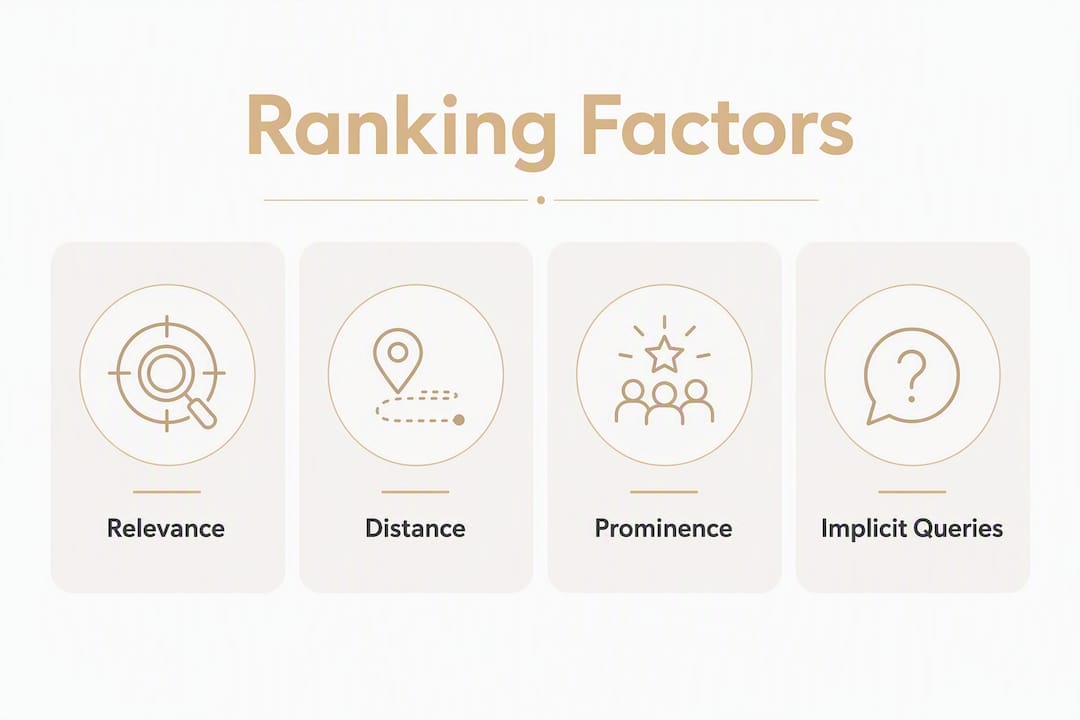
Relevance is how well your listing and website match what the searcher wants. A plumber who lists “emergency drain cleaning” as a service, uses that phrase on a dedicated page, and has it in their GBP description will outrank a plumber whose profile just says “plumbing.” Fill every GBP field, pick the most specific primary category available, and write location pages that name the service and the city in the same sentence.
Distance is the gap between your business and the searcher’s device. Google uses GPS signals from mobile devices, which means a competitor two blocks away from a searcher can outrank you even if your site is technically stronger. For storefronts, this is largely fixed. For service-area businesses (SABs), you can set a service radius in GBP, but you cannot manufacture proximity you do not have. The practical implication: invest heavily in Relevance and Prominence, because Distance is the one factor you cannot fully control.
Prominence is the hardest to build and the most durable once you have it. It reflects your real-world reputation online: review count and rating, local backlinks, citation consistency, and how often your brand appears across the web. A business with 200 Google reviews and mentions in local news will outrank a newer competitor with a perfect GBP setup, all else equal.
One thing most guides miss: implicit queries drive more local traffic than explicit “near me” searches. When someone types “dentist” into Google on their phone, Google returns a local pack just as it would for “dentist near me.” Optimizing only for the “near me” modifier leaves the larger audience untouched. Target the core service keyword, let Google handle the proximity signal, and you capture both query types.
Step-by-step implementation: GBP, on-page, reviews, citations, and measurement
Google Business Profile setup and hygiene
A complete, verified GBP is the single fastest lever for local visibility. Start here before touching your website.
- Enable messaging and booking — if your business type supports it. These features add conversion paths directly inside the map pack.
On-page local SEO: location pages and title tags
Each city or neighborhood you serve deserves its own page, not a paragraph buried on your homepage. A well-built location page maps to a single GBP listing and targets one primary keyword cluster (e.g., “HVAC repair Detroit” or “family dentist Ann Arbor”).
Title tag pattern: [Service] in [City] | [Business Name] — keep it under 60 characters. Never write “near me” in a title tag; it reads as spam and Google ignores it for proximity signals anyway.
H1 pattern: “HVAC Repair and Installation in Detroit, MI” — city and service in the same phrase, no keyword stuffing.
Page body: 300–600 words covering the service, the neighborhood context, hours, and a clear call to action. Mention nearby landmarks or neighborhoods naturally; it signals local relevance without sounding forced.
Internal links: link from your homepage and service pages to each location page. Google needs to crawl them to index them.
LocalBusiness schema: a working JSON-LD example
Structured data helps Google understand your hours, location, and rating without parsing prose. Add this to the <head> of every location page:
{
  "@context": "https://schema.org",
  "@type": "LocalBusiness",
  "name": "Acme Plumbing Detroit",
  "url": "https://www.acmeplumbing.com/detroit",
  "telephone": "+13135550100",
  "address": {
    "@type": "PostalAddress",
    "streetAddress": "1234 Main St",
    "addressLocality": "Detroit",
    "addressRegion": "MI",
    "postalCode": "48201",
    "addressCountry": "US"
  },
  "geo": {
    "@type": "GeoCoordinates",
    "latitude": 42.3314,
    "longitude": -83.0458
  },
  "openingHoursSpecification": [
    {
      "@type": "OpeningHoursSpecification",
      "dayOfWeek": ["Monday","Tuesday","Wednesday","Thursday","Friday"],
      "opens": "08:00",
      "closes": "18:00"
    }
  ],
  "aggregateRating": {
    "@type": "AggregateRating",
    "ratingValue": "4.8",
    "reviewCount": "127"
  }
}
Validate it with Google’s Rich Results Test before publishing. Accurate hours in schema also power the “open now” filter in Google Maps, which is a real conversion driver.
Reviews: building a repeatable process
A direct Google review link and a consistent follow-up cadence reduce friction enough to meaningfully increase review volume. Create your short review link from your GBP dashboard (Place ID finder → generate link), then send it via text or email within 24 hours of a completed job.
For negative reviews, respond within 48 hours. Acknowledge the issue, offer to resolve it offline, and keep the response under 100 words. A calm, professional reply signals to future customers that you handle problems well. Never argue in a public reply.
Pro Tip: Set a weekly calendar reminder to request reviews from that week’s customers. Consistency matters more than volume spikes. Google’s algorithm notices steady review velocity, not a one-time burst of 30 reviews followed by silence.
NAP consistency and citations
Your name, address, and phone number must match exactly across your website, GBP, Yelp, Apple Maps, Bing Places, and every directory where you appear. Even small discrepancies (“St.” vs. “Street”) can dilute local prominence signals. Correcting mismatched NAP data across directories is a foundational step that improves local rankings.
Start with a manual audit of your top five directories. Then submit or correct listings in Yelp, Apple Maps, Bing Places, and any industry-specific directories (Avvo for lawyers, Healthgrades for medical, Houzz for contractors). Consistency is the goal; quantity of listings matters less than accuracy.
Technical and mobile performance
Most “near me” searches happen on mobile. A page that loads in over three seconds on a phone loses a significant share of visitors before they ever read your address. Check your Core Web Vitals in Google Search Console, compress images to WebP format, enable server-level caching, and remove render-blocking scripts. If your site has common web design mistakes that hurt rankings, fix them before building more content.
Click-to-call must work on every location page. Test it on an actual phone, not just a browser emulator.
Local backlinks: three practical targets
- Local press: pitch a story angle to your city’s newspaper or neighborhood blog. A mention with a link from a .com local news site carries real weight.
- Chamber of commerce: most U.S. chambers offer a member directory listing with a dofollow link for an annual membership fee.
- Sponsorships: sponsor a local sports team, school event, or charity run. Most organizers publish a sponsors page with links.
How should multi-location and service-area businesses set up their listings?
The rule is simple: one verified GBP per physical location. For service-area businesses with no public storefront, set up a single SAB listing, hide the address, and define your service radius in GBP settings.
Do’s:
- Create one unique location page per city or neighborhood you serve, with original content on each
- Use a consistent URL pattern:
/locations/city-nameor/city-name-service - Link each location page to its corresponding GBP listing
- Collect and display reviews specific to each location where possible
- Use city-specific H1s and title tags on every page
Don’ts:
- Don’t create multiple GBP listings for the same physical address
- Don’t build thin location pages that swap only the city name and leave everything else identical
- Don’t target the same city keyword on two different pages; pick one canonical page per city and redirect or consolidate duplicates
- Don’t hide your address on a storefront GBP listing; that’s reserved for SABs only
Scaling location pages: build a template with fixed structural elements (schema, hours, map embed, CTA) and required local content blocks (neighborhood description, local testimonial if available, nearby service areas). Each page needs at least one paragraph of genuinely local content to avoid thin-content penalties. Templated location pages with automated review collection and reporting are how agencies manage 20+ location clients without producing duplicate content at scale.
For a three-location example: a law firm in Detroit, Ann Arbor, and Grand Rapids would use /detroit-personal-injury-lawyer, /ann-arbor-personal-injury-lawyer, and /grand-rapids-personal-injury-lawyer as separate pages, each with its own GBP, its own schema block, and at least 400 words of location-specific content.
What results should you expect, and what does it cost?
Many businesses see measurable GBP visibility changes within a few weeks of completing their profile and fixing NAP. Consistent growth in local pack rankings generally takes several months, depending on competition. Proxium’s own timeline guidance breaks this down further for businesses at different starting points.
| Action | Earliest measurable signal | Typical time to impact |
|---|---|---|
| Claim and complete GBP | Initial signals activate promptly | Shortly after |
| Fix NAP consistency | After some weeks (crawl cycle) | Within a few months |
| Publish location pages | Within weeks (indexing) | Within a few months |
| Review velocity increase | Within weeks (prominence signal) | Within a few months |
| Local backlink acquisition | Several weeks (crawl + index) | Within a few months |
| Schema deployment | Shortly after (Rich Results Test confirms) | Within weeks |
KPIs to track every month:
- GBP search views and map views (GBP Insights)
- Calls and direction requests from GBP
- Organic impressions and clicks for location pages (Google Search Console, filtered by page)
- Appointment form submissions or booking completions
- Local rank snapshots using a pin/grid tracker
Standard IP-based rank trackers miss local pack volatility because rank can shift block-by-block within a city. Use a grid-based local rank tracker to capture the real picture.
Effort and cost ranges:
DIY local SEO requires roughly 3–5 hours per week for the first two months (GBP setup, page writing, review requests, citation fixes), then drops to 1–2 hours per week for maintenance. Agency retainers for local SEO services vary based on market competition, number of locations, and scope. View Proxium’s pricing for Michigan-market ranges. Generally, single-location local SEO falls in a low-to-mid monthly retainer band; multi-location or competitive markets push into mid-to-high bands. The biggest cost driver is content: unique location pages and local link outreach take real time regardless of who does them.
Online reviews also carry direct revenue implications beyond rankings, which makes the review program one of the highest-ROI investments in the local SEO stack.
How Proxiumdigital implements “near me” SEO for local clients
Proxiumdigital’s process combines GBP remediation, location page builds, schema deployment, and a managed review program into a staged deliverable set that maps to the timeline above.
Process steps:
- Location page build: — one page per target city, with city + service H1, LocalBusiness schema, map embed, and internal linking
Deliverables clients receive: verified GBP listings, published location pages, deployed JSON-LD schema, a working review-request flow, and a monthly KPI dashboard.
Proxiumdigital integrates SEO directly into the website build rather than treating it as a separate layer. That means location pages load faster, schema is deployed correctly from day one, and clients avoid the rework cost that comes from fixing a site that was built without local SEO in mind.
Key Takeaways
Ranking for “near me” searches requires a complete Google Business Profile, consistent NAP data, location-specific pages with LocalBusiness schema, a steady review velocity, and local backlinks — all tracked monthly through GBP Insights and Google Search Console.
| Point | Details |
|---|---|
| GBP is the fastest lever | Claim, verify, and complete your GBP before any other local SEO work. |
| Implicit keywords drive more traffic | Queries like “dentist” trigger local packs just as “dentist near me” does; optimize for both. |
| Reviews build prominence over time | A weekly review-request cadence produces steadier prominence gains than one-time volume bursts. |
| Expect 3–6 months for consistent growth | GBP changes show in days; local pack ranking improvements solidify over 3–6 months. |
| Proxiumdigital handles the full stack | Proxiumdigital’s staged process covers GBP, location pages, schema, reviews, and monthly reporting for Michigan local businesses. |
The part most guides won’t say out loud
There is a version of “near me” SEO advice that treats Google’s algorithm as a puzzle to trick rather than a system designed to surface genuinely useful local businesses. You see it in guides that recommend cramming “near me” into H1 tags, building 50 thin city pages with swapped zip codes, or buying 200 directory citations in a single weekend. Those tactics produce short-term noise and long-term penalties.
What actually works is less exciting but far more durable: a business that is easy to find, easy to contact, and well-reviewed by real customers will outrank a technically optimized competitor within a few months. The algorithm is trying to answer the question “which business near this person is most likely to satisfy them?” Your job is to make the honest answer to that question be your business.
The two warnings worth repeating: first, keyword-stuffing “near me” into your copy does nothing for rankings and actively signals low quality to visitors who read it. Second, thin location pages that swap only the city name are a liability, not an asset. Google has been penalizing them since the Helpful Content updates, and the trend is not reversing.
Invest in one well-built location page per city, a review system that runs without you thinking about it, and a GBP that is maintained the way you maintain your storefront. That is the whole strategy.
Proxiumdigital’s local SEO services for Michigan businesses
If you want the work done rather than doing it yourself, Proxiumdigital builds and manages the full local SEO stack for Michigan service businesses and professional firms. The engagement starts with a technical audit and GBP review, moves into location page builds, schema deployment, and continues with monthly reporting and review program management.
The difference from hiring a generic agency: SEO is built into the site architecture from the start, not retrofitted onto a slow, poorly structured site. That means faster pages, correct schema from day one, and no rework bill six months in. Proxiumdigital’s local SEO optimization services cover everything in this guide, handled by a team that works specifically in the Michigan market.
To get started, request an audit through the Proxiumdigital services page. The audit identifies your highest-priority gaps across GBP, on-page, citations, and technical performance, and gives you a clear picture of what a full engagement would look like before you commit to anything.
Useful sources
- Tips to improve your local ranking on Google — Google’s official documentation on Relevance, Distance, and Prominence; the primary reference for local ranking factors.
- “Near Me” SEO: Optimize for Local Searches That Convert — Search Engine Land’s practitioner guide on balancing “near me” optimization with people-first content.
- SEO Near Me Strategy: How to Rank for “Near Me” Searches — ReviewTrackers on direct review links, NAP consistency, and review velocity for local prominence.
- How Long Does SEO Take to Work? Realistic Timelines — Proxiumdigital’s own timeline breakdown for local SEO improvements at different starting points.
- 7 Essential Automated SEO Tools for Agency Success — Practical overview of automation tools for scaling location-page and reporting workflows.
- Schema.org LocalBusiness — Reference documentation for structured data types used in local SEO schema implementation.
- How to Choose an SEO Agency in Detroit, Michigan — Proxiumdigital’s guide to evaluating local SEO agencies and what to expect from an engagement.
FAQ
What does “near me” SEO actually mean?
“Near me” SEO, more precisely called local search optimization, refers to the practice of improving a business’s visibility in Google’s local pack, Google Maps, and location-based organic results. It covers GBP setup, location pages, schema, reviews, and citations.
Does putting “near me” in my title tags help rankings?
No. Google resolves proximity from the searcher’s device GPS, not from the phrase on your page. Using “near me” in title tags or H1s looks spammy to visitors and provides no ranking benefit.
How long does it take to rank for local searches?
GBP changes show in days. Location page indexing takes days to weeks. Consistent local pack ranking improvements typically take 3–6 months, depending on competition and how quickly you build review velocity and local backlinks.
Do implicit keywords like “plumber Detroit” trigger the same local results as “plumber near me”?
Yes. Google uses device location to return local pack results for category queries even without the “near me” modifier. Optimizing for the core service and city keyword captures both query types.
Can Proxiumdigital handle multi-location local SEO?
Yes. Proxiumdigital builds and manages separate GBP listings, location pages, and schema for each target city, with a templated process that maintains unique local content per location and avoids duplicate-content issues.