Google Maps Ranking Factors: What Actually Moves Your Rank

Google names three ranking signals for Maps and the Local Pack: relevance, distance, and prominence. Everything else, from photo counts to review responses, feeds one of those three buckets. If you fix nothing else this month, claim and complete your Google Business Profile, pick the right primary category, get new reviews flowing consistently, clean up inconsistent business listings across directories, and publish at least one local landing page with LocalBusiness schema.
Practitioner data backs the urgency here. Ranking factor surveys tied to Google Maps ranking behavior suggest GBP and review signals together carry a large share of local pack weight, and Ahrefs’ own testing confirms categories and profile completeness remain the biggest levers most businesses leave untouched.
Do these three things in the next half hour:
- Confirm your Google Business Profile is verified and every field is filled out, not just the required ones.
- Check that your business name, address, and phone number match exactly across your website and top directories.
- Send a review request to your last five satisfied customers today.
Key Takeaways
Ranking higher on Google Maps comes down to optimizing relevance, distance, and prominence together, starting with a complete Google Business Profile and a steady review cadence.
| Point | Details |
|---|---|
| Three signals rule everything | Relevance, distance, and prominence determine every Google Maps ranking outcome. |
| GBP completeness comes first | A fully filled, correctly categorized profile outperforms most other early efforts. |
| Reviews need consistency | Steady weekly review velocity beats occasional bursts for prominence gains. |
| Proximity sets a ceiling | Distance can cap your rank regardless of profile quality in dense categories. |
| Integrated execution helps | Proxiumdigital builds local SEO into websites from the start to avoid NAP and schema gaps. |
Table of Contents
- What Are the Google Maps Ranking Factors, Exactly?
- Which Ranking Factors Should You Fix First?
- How Do You Optimize a Google Business Profile Field by Field?
- How Much Do Reviews Actually Affect Map Rankings?
- Do Citations and NAP Consistency Still Matter?
- Does Your Website Actually Affect Google Maps Rank?
- How Do Links and Behavior Signals Build Prominence?
- Can You Outrank a Closer Competitor on Google Maps?
- What’s a Realistic 30/90/180-Day Plan for Ranking Higher?
- How Long Does It Take to Rank Higher on Google Maps?
- What Do Agency Case Patterns Reveal About What Actually Works?
- Sources
- FAQ
What Are the Google Maps Ranking Factors, Exactly?
Google matches what someone searches for to a specific business entity using three signals: how relevant your listing is to the query, how close you are to the searcher (or the area they searched), and how prominent your business is overall. Every optimization tactic you’ve heard of, from posting weekly updates to chasing backlinks, ultimately tries to move the needle on one of those three.
Relevance depends heavily on structured data you control directly: your primary category, additional categories, business description, services list, and even the words customers use in their reviews. Distance is mostly out of your hands. It’s calculated between the searcher’s location (or the location implied in their search) and your listed address or service area. Prominence is the fuzziest of the three. It blends your review profile, your website’s authority, local citations, and how well-known your business is offline.
Here’s how the pieces typically map to each bucket:
- Relevance: primary/secondary categories, business description, services and products list, keywords in reviews.
- Distance: your registered address, service area radius, and the searcher’s physical location or search-area intent.
- Prominence: review count and rating, backlinks and local mentions, citation consistency, overall brand recognition.
Tactics like Google Posts, photo uploads, and Q&A management don’t sit neatly in any one bucket. They act as proxies. Posting regularly signals an active business, which supports prominence. Answering Q&A promptly and accurately reinforces relevance by embedding the right keywords into your profile naturally.
Google’s own guidance is blunt about this: local results are based mainly on relevance, distance, and prominence, and the completeness and accuracy of your profile is what helps Google match you to the right searches in the first place.
If you’re not sure where your profile stands today, Google Business Profile Help has a live dashboard showing verification status, insights, and any pending suspensions or policy flags. Check that before you touch anything else.
Which Ranking Factors Should You Fix First?
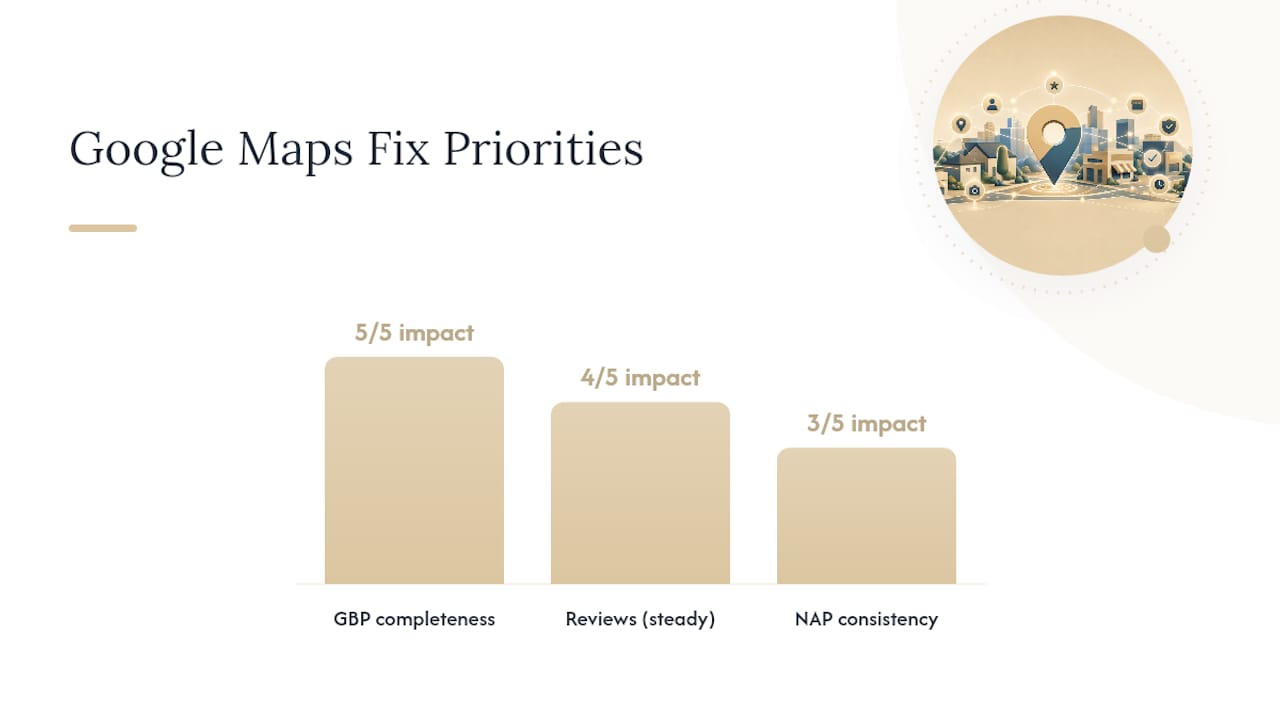
Not every factor deserves equal attention. Some move rank within days; others take months and barely register unless you’re already close to page one.
The factor groups you need to know:
- GBP fields and categories — highest impact, fastest to fix, entirely within your control.
- Reviews (volume, recency, sentiment) — high impact, moderate effort, ongoing process.
- Citations and NAP consistency — moderate impact, one-time cleanup with occasional maintenance.
- On-site signals and local pages (schema, content) — moderate to high impact, one-time build.
- Links and mentions — supporting signal, slow to build, compounds over time.
- Behavioral signals (clicks, calls, direction requests) — reinforcing signal, improves as the others improve.
- Photos, Posts, and Q&A — supporting signals for freshness and conversion.
- Proximity — largely fixed, sets a ceiling you can’t optimize past.
Run this three-question self-audit before reading further: Is your GBP 100% complete with the correct primary category? Have you received a new review in the last 30 days? Does your website list the exact same name, address, and phone number as your GBP listing?
| Point | Details |
|---|---|
| GBP completeness first | Fill every available field, not just name, address, and phone. |
| Reviews compound weekly | Aim for a steady trickle of new reviews rather than periodic bursts. |
| NAP consistency is free | Fixing mismatched listings costs time, not money, and removes confusion signals. |
How Do You Optimize a Google Business Profile Field by Field?
Your Google Business Profile is the foundation everything else builds on. Fix it before spending time on links, schema, or outreach.
- Business name — use your real, registered name exactly as it appears on your storefront or legal paperwork. Adding keywords like “Detroit Best Plumber LLC” violates Google’s representation guidelines and risks suspension.
- Primary category — pick the single most accurate category for your core service. This carries more relevance weight than any other field on your profile.
- Additional categories — add every category that genuinely applies, but resist padding the list with categories customers wouldn’t search for.
- Services and products — list specific services with short descriptions; this is searchable text Google indexes for relevance matching.
- Address and service area — set a physical address if you have a storefront, or configure a service-area business if you work at client locations.
- Phone and website — use a local number where possible and link directly to a page that matches the listing’s category.
- Hours — keep them current, including holiday hours; stale hours hurt both ranking and conversion.
- Attributes — check every relevant attribute (wheelchair accessible, women-owned, outdoor seating) since these feed niche relevance queries.
- Photos and description — upload real photos regularly and write a description that mentions your services naturally, without keyword stuffing.
- Q&A — seed it yourself with the three or four questions customers ask most often.
Pro Tip: Seed your own Q&A section before customers do. Post honest questions like “Do you offer same-day service?” and answer them yourself. This fills relevance gaps and prevents competitors or trolls from posting misleading answers.
For service-area businesses without a public storefront, hide your address and define your service area by city or zip code radius instead. This keeps you compliant with Google’s policies while still surfacing in nearby searches.
Quick don’ts:
- Don’t create duplicate listings for the same location.
- Don’t stuff keywords into the business name field.
- Don’t leave the “opening date” field blank if you know it.
How Much Do Reviews Actually Affect Map Rankings?
Reviews are one of the largest prominence signals Google factors in, and recency matters nearly as much as total count. A profile with 200 reviews from three years ago won’t outperform a competitor with 60 reviews and five new ones this month.
The mechanics are straightforward once you build a system:
- Ask every satisfied customer, in person or by text, within 24 to 48 hours of service completion.
- Never offer incentives or gate reviews by filtering out unhappy customers before asking. This violates policy and creates artificial sentiment patterns Google can detect.
- Respond to every review, positive or negative, within a few business days. A thoughtful response to a negative review often reassures future customers more than five-star silence does.
- Track review velocity (new reviews per month), average rating, and the percentage of reviews from the last 90 days as your core KPIs.
A simple response template for a negative review: “Thanks for the feedback, [name]. We’re sorry the experience didn’t meet expectations. We’d like to make this right. Please reach out to us directly at [contact] so we can address it.” Short, specific, and it shows future customers you engage rather than ignore complaints.
What counts as review gating, and why does it matter?
Filtering which customers get asked to leave a review based on their expected sentiment is review gating, and it violates Google’s policies. Ask everyone, every time, regardless of how the interaction went.
Do Citations and NAP Consistency Still Matter?
Yes, though their role has shifted from “ranking booster” to “trust hygiene.” Inconsistent name, address, and phone information across directories splits the trust signal Google uses to confirm your business actually exists where you say it does.
Audit your top 20 to 30 citations against your GBP listing exactly, checking spelling, suite numbers, and phone formatting. Prioritize fixes in this order:
- Primary data aggregators and major directories first (they feed dozens of smaller sites automatically).
- Industry-specific associations and licensing bodies next.
- Local press mentions and chamber of commerce listings last, since these carry prominence value beyond simple NAP matching.
Quantity of citations matters less than it used to. A handful of accurate, high-authority citations outperforms fifty scattered, inconsistent ones. For multi-location businesses, audit each location separately since a single citation error can quietly drag down one storefront while the others rank fine.
| Point | Details |
|---|---|
| Audit before building | Fix existing inconsistent listings before adding new citations. |
| Quality over volume | A few accurate, high-authority citations beat dozens of low-quality ones. |
| Multi-location = multi-audit | Check each storefront’s NAP independently rather than assuming consistency. |
Does Your Website Actually Affect Google Maps Rank?
Your website confirms what your Google Business Profile claims. If your GBP says you serve three neighborhoods but your site never mentions them, you’re leaving relevance signals on the table.
- Build a dedicated page for each service area or location, with unique content, not a copy-pasted template swapping out city names.
- Structure each page with an H1 that names the service and location together, then supporting H2s covering specific services, service area boundaries, and local landmarks or neighborhoods.
- Add LocalBusiness schema to your site with name, address, phone, geo-coordinates, opening hours, and price range so search engines can parse your business details programmatically.
- Keep your NAP identical between every location page and your GBP listing.
Pro Tip: Page speed and mobile usability aren’t just user experience concerns. Slow local pages increase bounce rates, which weakens the behavioral signals Google reads as a sign searchers found what they wanted.
How Do Links and Behavior Signals Build Prominence?
Local, relevant links move prominence more than generic backlinks ever will. A mention from your local chamber of commerce or a regional news write-up tells Google you’re a real, recognized business in that geography, which matters more for Maps than for organic rankings.
High-value mention sources worth pursuing:
- Local news coverage or sponsorships.
- Chamber of commerce and business association directories.
- Supplier or partner pages that list you as a vendor or contractor.
Behavioral signals matter too. Click-throughs to your website, direction requests, phone calls placed directly from your listing, and booking clicks all tell Google your profile satisfies searchers. You can encourage these by keeping your CTA buttons active (booking links, messaging) and making sure your listed phone number connects directly, not through a call-tracking number that looks suspicious to Google.
Building local prominence, practically
Reach out to organizations you’re already connected to, suppliers, local nonprofits you’ve sponsored, industry groups, and ask for a simple web mention. These low-effort, high-relevance links often outperform expensive backlink campaigns.

Managing Photos, Posts, and Q&A for Freshness
High-quality photos, regular Google Posts, and a well-managed Q&A section support both conversion and the freshness signals Google rewards.
- Upload at least four to six new photos monthly covering your team, location, and completed work, not stock images.
- Publish a Google Post every one to two weeks; even a simple update about hours or a seasonal offer counts.
- Seed your Q&A with your three most common customer questions and monitor weekly for incorrect answers from the public.
- Flag or correct any inaccurate Q&A responses promptly since anyone can post an answer.
Can You Outrank a Closer Competitor on Google Maps?
Distance often sets a ceiling no amount of profile polishing can break through. If a competitor sits four blocks from a searcher and you’re two miles away, prominence and relevance improvements narrow the gap, but they rarely close it entirely for hyperlocal searches.
Ranking factor data from practitioner surveys, including analysis referenced by vrid.ai, consistently finds proximity dominates in dense, competitive categories like restaurants or auto repair, where dozens of businesses sit within a few miles of each other.
Pro Tip: Run geo-grid tests using a map pack rank checker from multiple points across your target area, not just your office address. This reveals exactly which neighborhoods you’re realistically competing in versus which ones you’re structurally locked out of.
When you hit a proximity ceiling, your realistic options narrow:
- Expand your service-area radius in GBP if your business model supports travel.
- Build dedicated landing pages targeting specific neighborhoods where you can realistically compete.
- Supplement with paid local ads in zones where organic Maps visibility isn’t achievable.
What’s a Realistic 30/90/180-Day Plan for Ranking Higher?
Trying to fix everything simultaneously makes it impossible to tell what worked. Sequence your effort instead.
Days 0 to 30: Claim and fully complete your GBP, correct your primary category, fix hours, resolve NAP mismatches across your top ten citations, and remove any duplicate listings.
Days 30 to 90: Launch a consistent review-request process, publish your first local landing pages with schema, and continue citation cleanup down your priority list.
Days 90 to 180: Begin local link outreach and press mentions, maintain review velocity, and A/B test your local pages against small content or CTA changes.
Track these KPIs at each phase:
- Map pack position, checked from multiple neighborhoods, not just your office.
- Review velocity and average rating trend.
- Direction requests and phone calls from your GBP insights.
- Website conversions originating from local landing pages.
Recommended tools by task:
- Geo-grid rank checks: a map pack rank checker or GeoRankTracker to see visibility by coordinate.
- Review monitoring: your GBP dashboard combined with a simple spreadsheet tracking velocity monthly.
- Citation tracking: manual audits quarterly for single-location businesses; a tracking tool for multi-location brands.
- Schema validation: Google’s Rich Results Test against your LocalBusiness markup.
How Long Does It Take to Rank Higher on Google Maps?
Expect early movement within four to eight weeks for GBP fixes like category corrections and completeness improvements. Review-driven prominence gains build more slowly, typically three to six months of consistent activity before they visibly shift rank. Link-based prominence work often takes the longest, sometimes six months or more before it registers.
Cost isn’t fixed the way a fee schedule would be; it’s really an effort trade-off. Handling this yourself demands ongoing weekly time for reviews, monthly time for content and citations, and periodic technical work for schema. Hiring an agency for SEO optimization shifts that time cost into a monthly retainer, with the tradeoff of specialized execution and reporting. Neither path is free; you’re paying with time or with budget.
Common mistakes that waste that effort:
- Keyword-stuffing your business name, risking a policy suspension.
- Creating duplicate listings for the same address.
- Gating reviews by only asking happy customers.
- Leaving NAP inconsistent across even a handful of directories.
- Changing five variables at once so you can’t tell what actually worked.
Check-in checklist: after 30 days, confirm GBP completeness and citation fixes; after 90 days, confirm review velocity and local page indexing; after 180 days, confirm rank movement across your geo-grid test points.
What Do Agency Case Patterns Reveal About What Actually Works?
Across local service clients, the pattern repeats: GBP completeness, steady review flow, and localized website pages together produce the largest and fastest visibility gains, well before link building or advanced technical work start paying off.
The businesses that see the fastest map pack movement are rarely the ones with the biggest link-building budgets. They’re the ones that fixed their category, kept reviews coming in every week, and built pages that actually named their service areas.
A Michigan-based home services client saw direction requests increase within the first 90 days after correcting a mismatched primary category and closing a six-month gap in new reviews. A separate professional services client improved local page indexing and call volume simply by replacing duplicate location pages with unique, schema-marked content.
- Fix GBP completeness before touching anything else.
- Treat reviews as an ongoing weekly process, not a one-time push.
- Build local pages that name specific neighborhoods, not generic city-wide copy.
Bryan, Proxiumdigital, has watched these patterns hold across dozens of local service accounts in Metro Detroit.
A publisher’s honest take on the roadmap
Doing this well takes real time, and there’s no shortcut around the review-building or citation-cleanup grind. What surprises most business owners isn’t the individual tactics; it’s how much a fragmented approach, where a website vendor and an SEO vendor never talk to each other, quietly undermines all of it. NAP mismatches between your site and your GBP often trace straight back to a web design vendor who never checked your existing listings. If you’d rather have someone execute this roadmap end-to-end instead of juggling five vendors, that’s exactly the gap an integrated team closes.
Where Proxiumdigital fits if you’d rather not DIY this
Proxiumdigital builds websites with local SEO baked in from day one, rather than bolting it on after launch, which is where most of the NAP and schema problems above actually originate. Instead of coordinating a web designer and an SEO vendor who’ve never spoken to each other, you get one team handling both, plus ongoing monthly reporting so you can actually see review velocity and rank movement over time.

If you want a professional read on where your listing currently stands, Proxiumdigital’s SEO optimization services start with a profile and citation audit before recommending any paid work. For businesses that also need their website rebuilt with local pages and schema done correctly the first time, the integrated SEO, web design, and website management services cover both under one plan. Michigan business owners who want to compare packages before committing can check current pricing directly. The next step is simple: request a profile audit and find out exactly which of the factors above are costing you visibility right now.
Sources
- Tips to improve your local ranking on Google - Google Business Profile Help
- Google Maps SEO: 5 Proven Strategies to Rank Higher - Ahrefs
- Schema
- Vrid
- Map Pack Rank Checker - Ranking SEO Check
FAQ
What are the ranking factors for Google Maps?
Google names three: relevance (how well your profile matches the search), distance (how close you are to the searcher), and prominence (your overall reputation and authority, driven largely by reviews and links).
Is 4.7 a good Google rating?
Yes, a strong rating signals high customer satisfaction, though what matters more for ranking is review recency and volume alongside the score itself.
How long does it take to rank higher on Google Maps?
GBP fixes can show movement in four to eight weeks, while review and link-driven prominence gains typically take three to six months of consistent effort.
Can I rank on Google Maps without a physical storefront?
Yes, using a service-area business setting in your Google Business Profile, which hides your address while still targeting the neighborhoods you serve.
Does Proxiumdigital help with Google Maps optimization specifically?
Yes, Proxiumdigital’s SEO services include Google Business Profile audits, local landing page builds with schema, and ongoing review and citation monitoring for Michigan-based local businesses.