Google AI Overviews SEO: A 2026 Practitioner’s Playbook

Google AI Overviews are AI-generated, citation-backed summaries that synthesize multiple indexed pages and surface supporting links directly in search results. To earn a citation, three priorities matter above everything else: (1) people-first, semantically complete content that directly answers the query; (2) extractable facts formatted as short lists, tables, or Q&A blocks; and (3) earned third-party mentions that signal authority to Google’s retrieval systems.
Start measuring now. The Generative AI performance report in Google Search Console tracks supporting-link impressions and clicks for your pages. Pull that report before making any changes so you have a clean baseline.
- Priority 1: Write direct answers in the top 30% of each page. Industry analysis indicates that a majority of AI Overview citations pull from the top portion of a page. (https://thestacc.com/blog/optimize-google-ai-overviews/).
- Priority 2: Use lists, tables, and short Q&A blocks. Pages with original data tables tend to earn citations at a notably higher rate than pages with prose-only content.
- Priority 3: Build earned mentions. AI retrieval systems show a measurable bias toward third-party, authoritative sources over brand-owned content.
Proxiumdigital’s approach to AI Overview readiness starts with an integrated audit covering technical structure, content micro-formatting, and earned-media gaps. The goal is not to “trick” the retrieval system. It is to become the most extractable, credible source on a topic.
Key Takeaways
Earning AI Overview citations requires people-first content, extractable formatting, and earned third-party authority, measured weekly through Search Console’s Generative AI performance report.
| Point | Details |
|---|---|
| Place answers in the top 30% | 55% of AI Overview citations pull from the top 30% of a page; move direct answers above the fold. |
| Prioritize tables and lists | Pages with original data tables earn citations at 4.1x the rate of prose-only pages. |
| Build earned media systematically | AI retrieval systems favor third-party sources; treat PR outreach as an SEO function. |
| Monitor Search Console weekly | The Generative AI performance report tracks supporting-link impressions and clicks; set a baseline before any changes. |
| Use controls conservatively | Noindex and nosnippet remove pages from AI Overview eligibility; default to content improvement first. |
| Proxiumdigital pilot audit | Proxiumdigital’s integrated SEO audit covers trigger analysis, technical fixes, content restructuring, and a measurement dashboard. |
Table of Contents
- What are Google AI Overviews and when do they appear?
- How Google AI Overviews SEO actually works: the retrieval pipeline
- Why AI Overviews change your traffic math
- What Google’s official guidance actually says
- Technical SEO checklist for AI Overview eligibility
- [Question-focused H2]
- Content micro-structure: what formats get cited most
- Why earned media matters more than you think
- How to measure AI Overview visibility and track performance
- Myths about AI Overviews and the controls that actually work
- Your 6–8 week implementation plan
- What GEO research tells us about AI citation bias
- Three things to start today
- An editorial perspective on AI Overview readiness
- How Proxiumdigital approaches AI Overview readiness
- Sources
- FAQ
What are Google AI Overviews and when do they appear?
AI Overviews are Google’s generative search feature: a synthesized, paragraph-style answer that appears above organic results for qualifying queries. They are not featured snippets. A featured snippet pulls a single excerpt from one page. An AI Overview synthesizes information across multiple pages, then lists supporting links the reader can follow to learn more. Think of it as Google writing a short briefing document from your content, then crediting the sources.
The underlying mechanism is retrieval-augmented generation (RAG). Google retrieves a pool of indexed, high-quality pages, feeds them into a language model as grounding context, and generates a synthesized answer. The supporting links shown are drawn from those retrieved pages.
Query types most likely to trigger AI Overviews:
- Complex informational queries with multiple sub-questions (“how does X work and what are the risks”)
- Research-style queries where a synthesized overview adds more value than a single source
- Multi-step how-to sequences (“how to set up X from scratch”)
- Comparison queries where the answer requires weighing several factors
- Definition queries for technical or nuanced topics
Google’s own promotional page for AI Overviews describes the feature as a “jumping-off point” that surfaces links for users to explore further. That framing matters strategically: Google is not trying to replace your page. It is trying to decide which pages are worth sending readers to.
Geographic rollout has been uneven. AI Overviews are most prevalent in the United States and have expanded to additional markets and query types through 2025 and into 2026. MarTech’s coverage of the expansion documents the feature’s growth into more complex search categories. People Also Ask boxes and featured snippets still coexist with AI Overviews on the same SERP, but the synthesized summary typically occupies the most prominent real estate above them.
How Google AI Overviews SEO actually works: the retrieval pipeline
Understanding the pipeline is what separates tactical guessing from deliberate optimization. Google’s process follows a clear sequence, and each stage is a point where your content can either qualify or get filtered out.
The pipeline in plain terms:
- Query fan-out: Google expands the original query into multiple sub-queries to retrieve a broader candidate pool of pages.
- Retrieval: Core ranking systems identify indexed pages relevant to those sub-queries. Crawlability and indexability are prerequisites here. A page Google cannot access does not enter the pool.
- Synthesis (grounding): The language model reads the retrieved pages and generates a synthesized answer, grounded in the actual text of those pages.
- Supporting links: Pages whose content was used in grounding are surfaced as supporting links.
Google’s developer documentation confirms this RAG architecture: AI Overviews retrieve indexed pages, then synthesize grounded answers and show supporting links drawn from those retrieved pages.
What this means for formatting: the model extracts short, self-contained facts. A heading followed by a two-sentence direct answer followed by a short bullet list is far easier to extract than a 600-word narrative paragraph where the key claim is buried in sentence 14. The model does not read your page the way a human does. It scans for structured, extractable units of meaning.
The retrieval system is more likely to surface content it encounters early and can parse without ambiguity.*
Why AI Overviews change your traffic math
The business impact is real and already measurable. A Pew Research field study found that AI summaries appeared on roughly 18% of sampled queries, and that link clicks fell to 8% when a summary was present versus 15% without one.
That is the zero-click reality. But the picture is not uniformly negative for publishers.
Measurable outcomes to track:
- Organic CTR shifts: Top-position CTR drops when an AI Overview occupies the space above results. Expect this for informational queries.
- Supporting-link clicks: Pages cited as supporting links receive clicks from users who want to go deeper. These tend to be higher-intent visitors.
- Time on site: Supporting-link visitors typically spend more time on page than a standard organic visitor arriving from position 5 or lower.
- Conversion rate per supporting-link visitor: Because these visitors have already read a synthesized answer and chose to click through, conversion rates often run higher than average organic.
Consider the contrast directly. A user who clicks your page from organic position 1 on a broad informational query may be in early research mode. A user who clicks your supporting link after reading an AI Overview has already absorbed a synthesis of the topic and is clicking specifically because your page was cited as a source. That is a different kind of visitor, and your analytics should treat them differently.
Use Search Console alongside Google Analytics to reconcile impressions, clicks, and assisted conversions. The Generative AI performance report in Search Console is the primary surface for supporting-link data. Pair it with Analytics segments to see what those visitors do after they land.
What Google’s official guidance actually says
Google has been clear: there is no separate optimization track for AI Overviews. Google’s developer guidance states that generative AI features are rooted in core Search ranking systems and that foundational SEO best practices remain the primary path to visibility.
That is not a hedge. It is a strategic signal. The same signals that earn a page high organic rankings, quality content, clean technical structure, and earned authority, are the signals that make a page eligible for AI Overview citation.
Site-owner controls that affect AI Overview inclusion:
- robots.txt: Blocking Googlebot prevents crawling entirely. The page cannot be indexed and cannot be cited.
- noindex: Removes the page from the index. No index, no AI Overview citation.
- nosnippet: Prevents Google from showing any snippet from the page, including in AI Overviews.
- data-nosnippet: Applies at the HTML element level. Use it to exclude specific sections (a legal disclaimer, a pricing table) while keeping the rest of the page eligible.
- max-snippet: Limits the character length of any snippet. Setting it to 0 has the same effect as nosnippet.
Myths Google explicitly dispels:
- You do not need a special
llms.txtfile to be eligible. - No unique schema type “unlocks” AI Overview inclusion.
- There is no whitelist to apply to.
Monitor the Generative AI performance report in Search Console as your primary measurement surface. It is Google’s official data on how your pages perform as supporting links.
Technical SEO checklist for AI Overview eligibility
Clean technical structure is the floor, not the ceiling. A page that fails basic crawlability or indexability never enters the retrieval pool, regardless of content quality. Work through this checklist before investing in content restructuring.
- Audit robots.txt. Confirm that Googlebot is not blocked from pages you want cited. Use Google Search Console’s URL Inspection tool to verify.
- Check indexability. Run a crawl with a tool like Screaming Frog or Sitebulb. Flag any pages with noindex tags that should be eligible for citation.
- Submit and maintain an XML sitemap. Keep it current. Stale sitemaps slow discovery of new or updated content.
- Address JavaScript rendering. If your site relies heavily on client-side rendering, Google may not see the full page content. Use server-side rendering or pre-rendering for content-heavy pages. Proxiumdigital’s web design services handle server-side rendering as part of the build, so content is immediately accessible to crawlers.
- Validate structured data. Use Google’s Rich Results Test. Structured data must match visible page text. Mismatches signal low trust to the retrieval system and reduce extractability.
- Assess page experience signals. Core Web Vitals (LCP, CLS, INP) affect ranking, and ranking affects retrieval pool eligibility. A slow page that ranks poorly is less likely to be retrieved.
- Resolve canonicalization issues. Duplicate content across URLs splits authority. Set canonical tags correctly so link equity and content signals consolidate on the intended URL.
- Use semantic HTML structure. Heading hierarchy (H1 → H2 → H3) should reflect content structure, not visual design. The retrieval model uses heading context to understand what a section is about.
For a deeper primer on crawlability and indexability fundamentals, Proxiumdigital’s technical SEO guide covers the core concepts in plain language.
Pro Tip: Keep structured data accurate and tightly matched to visible text. A schema markup that claims a FAQ answer the page does not actually contain is a trust signal in the wrong direction.
A simple page pattern that AI can extract cleanly:
## [Question-focused H2]
[2–3 sentence direct answer]
- Fact one with a specific number or definition
- Fact two with a specific number or definition
- Fact three with a specific number or definition
That structure gives the retrieval model a clear heading context, a grounded answer, and discrete extractable facts. It works for how-to content, comparison content, and definition content alike.
Content micro-structure: what formats get cited most
Format is not cosmetic. The retrieval model extracts structured units of meaning, and some formats are significantly easier to extract than others. An industry analysis reports that pages with original data tables earn 4.1x more citations than pages without them.
Recommended micro-structure for citation-friendly pages:
- H2 (question-focused): Frame the heading as the query the user typed.
- 2–3 sentence direct answer: State the answer immediately. Do not build to it.
- 3 short bullet facts or a concise table: Give discrete, extractable data points.
- Inline source reference (optional): A one-line attribution increases credibility signals.
| Format | Relative citation rate | Best query type |
|---|---|---|
| Original data tables | Highest (4.1x vs. prose-only) | Research, comparison, statistics |
| Numbered lists | High | How-to, step sequences, rankings |
| Short Q&A blocks | High | Definition, FAQ, troubleshooting |
| Concise paragraphs | Moderate | Context, nuance, narrative |
| Long prose paragraphs | Lowest | Rarely extracted directly |
Dos and don’ts for citation-friendly content:
- Do include specific numbers, named steps, and defined terms. Vague claims (“many businesses benefit”) give the model nothing to extract.
- Do write semantically complete answers. A page that answers the main question and two related sub-questions is more likely to be retrieved across multiple fan-out sub-queries.
- Do use tables for any comparison or multi-attribute data. Tables are among the most extractable formats available.
- Don’t publish thin variations of existing content hoping to multiply citation chances. Google’s quality systems detect low-value content, and thin pages rarely enter the retrieval pool.
- Don’t write for the AI Overview at the expense of the human reader. People-first content and AI-extractable content are the same thing done well.
Pro Tip: SEMrush’s GEO guidance frames generative engine optimization as complementary to SEO, not a replacement. Publish consistently, make content accessible to AI crawlers, and earn credible mentions. Those three actions compound.
Why earned media matters more than you think
The GEO research preprint on arXiv found that generative AI systems systematically favor earned third-party media over brand-owned content. This is not a minor preference. It is a structural bias in how retrieval systems assess credibility. A page on your own domain claiming you are an authority is weaker evidence than a trade publication, an academic source, or an independent analyst citing you.
This changes the earned-media calculus for SEO teams. Backlinks have always mattered for rankings. But for AI Overview citations, the quality and independence of the source mentioning you carries additional weight. A mention in a niche trade publication that Google trusts may do more for your AI visibility than ten links from low-authority directories.
Tactical earned-media playbook:
- Publish original data. A proprietary dataset, a survey, or a benchmark study gives journalists and analysts something to cite that they cannot get elsewhere.
- PR outreach to trade publications. Pitch the data story, not the brand story. Editors want findings, not press releases.
- Guest analysis and contributor pieces. Writing for respected industry outlets builds both backlinks and the kind of third-party mention that AI retrieval systems weight heavily.
- Monitor unlinked brand mentions. Use tools like Google Alerts or a platform like Ahrefs to find mentions of your brand or data that do not include a link. Outreach to convert those into linked citations.
- Build relationships with researchers and analysts. Being cited in academic or research contexts carries strong credibility signals.
A practical workflow: publish a dataset or benchmark on your site → pitch the findings to three to five relevant trade publications → earn coverage with links → track whether those earned citations correlate with increased supporting-link appearances in Search Console.
One warning worth stating plainly: avoid any scheme that manufactures fake mentions, mass-submits to low-quality directories, or attempts to game citation counts with artificial signals. Google’s spam systems are trained to detect manipulative patterns, and the penalty for scaled content abuse is removal from the retrieval pool entirely.
How to measure AI Overview visibility and track performance
Measurement without a baseline is guesswork. Set your baseline before making any changes, then track weekly for 8–12 weeks to see meaningful signal.
- Open the Generative AI performance report in Google Search Console. This is the primary data source for supporting-link impressions and clicks. Filter by date range and export the raw data.
- Pull top queries. Identify which queries are already triggering AI Overviews where your pages appear as supporting links.
- Pull landing pages. See which pages are earning supporting-link clicks. These are your citation-ready pages. Study their structure and replicate it.
- Calculate supporting-link CTR. Divide supporting-link clicks by AI Overview impressions for those queries. This is your baseline citation click-through rate.
- Segment in Google Analytics. Create a segment for sessions that arrive via supporting links. Compare their time on site, pages per session, and conversion rate against your average organic visitor.
- Track assisted conversions. A supporting-link visitor who converts on a second visit still counts. Use Analytics attribution to capture that.
Two KPIs worth tracking from day one:
- Supporting-link CTR: Supporting-link clicks divided by AI Overview impressions. Tracks how often being cited actually drives a visit.
- Conversion rate of supporting-link visitors vs. organic top-result visitors: Measures whether the higher-intent hypothesis holds for your audience.
Pro Tip: Before a major content restructure, export a snapshot of your top 50 queries and their SERP formats from Search Console. After 8 weeks, compare citation rates for the restructured pages against the baseline. That delta is your evidence of what worked.
Recommended cadence: weekly check of the Generative AI report for the first 8 weeks after any significant change, then bi-weekly once patterns stabilize. Store monthly snapshots so you can track trends across quarters.
Myths about AI Overviews and the controls that actually work
Several pieces of misinformation circulate widely enough that they are worth addressing directly.
Myth vs. truth:
- Myth: Adding a
llms.txtfile will opt your site out of AI Overviews. Truth: Google has stated explicitly that no such file affects AI Overview eligibility. The controls that work are the ones Google has documented: robots.txt, noindex, nosnippet, data-nosnippet, and max-snippet. - Myth: A specific schema type will trigger AI Overview inclusion. Truth: No schema type guarantees inclusion. Schema helps Google understand content, but eligibility depends on quality and ranking signals, not markup alone.
- Myth: Being cited in an AI Overview always reduces your traffic. Truth: Supporting-link clicks can drive high-intent traffic. The Pew data shows lower overall click rates, but the clicks that do happen tend to come from more engaged users.
- Myth: You can reverse-engineer the exact pages Google will cite. Truth: The retrieval pool changes with every query. Optimize for extractability and authority across your content, not for a specific SERP slot.
Controls and their consequences:
- robots.txt (Disallow): Blocks crawling. The page cannot be indexed or cited. Use only for pages that must not be discovered at all.
- noindex: Removes from the index. Eliminates organic ranking and AI Overview eligibility simultaneously. Use for thin, duplicate, or private pages only.
- nosnippet: Prevents any snippet, including AI Overview citations. The page can still rank organically, but its content will not appear in AI features. Use when content must not be excerpted (legal, sensitive data).
- data-nosnippet: Element-level control. Apply to specific HTML sections you want excluded while keeping the rest of the page eligible. The most surgical option available.
- max-snippet: Sets a character limit on snippets. Setting it to 0 is equivalent to nosnippet.
The general principle: opt-out controls are destructive to discovery. If a page is underperforming in AI Overviews, the better path is improving content quality and structure. Reserve noindex and nosnippet for content that genuinely must be suppressed, not for pages you are frustrated are not being cited.
Before deploying any control site-wide, test it on a single URL in a staging environment. Verify the effect using the URL Inspection tool in Search Console. Confirm the page behaves as expected before rolling out broadly.
Your 6–8 week implementation plan
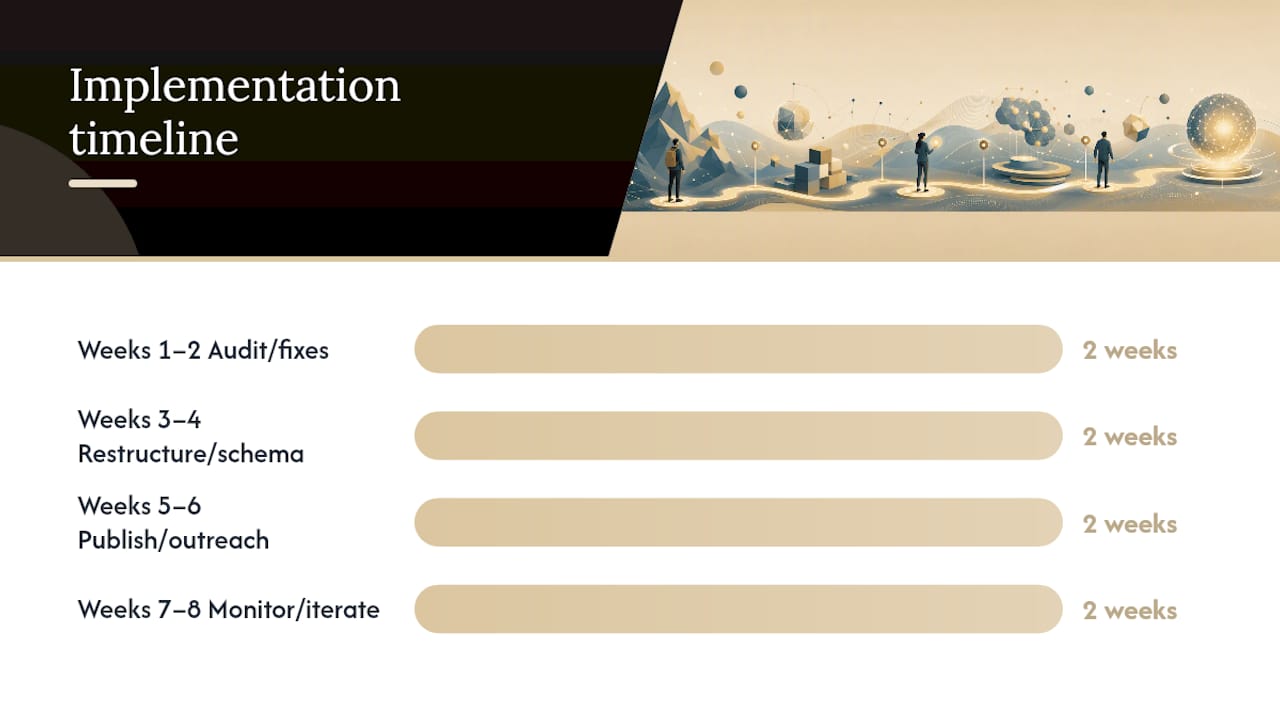
This timeline is designed for a team with an SEO lead, a content writer, a developer, and a PR or outreach owner. Adjust ownership as your team structure requires.
Weeks 1–2: Audit and quick technical fixes
- Run an AI Overview trigger audit for your top 20 target keywords. Note which queries show AI Overviews and whether your pages appear as supporting links.
- Crawl the site with Screaming Frog or Sitebulb. Flag noindex tags, robots.txt blocks, and JavaScript rendering issues on target pages.
- Pull the Generative AI performance report from Search Console and export your baseline data.
- Fix critical crawlability and indexability issues. Prioritize pages that rank in positions 1–10 but are not appearing as supporting links.
Weeks 3–4: Content restructures and schema
- Restructure the top 10 target pages using the question-focused H2 → direct answer → short bullet list pattern.
- Add or update structured data (FAQ, HowTo, Article schema) where it matches visible content.
- Verify structured data with Google’s Rich Results Test after each update.
- Identify pages with long prose sections that bury the key answer. Move the answer to the top.
Weeks 5–6: Publish original data and begin outreach
- Publish at least one original dataset, survey result, or benchmark table on a high-priority topic.
- Draft outreach emails to three to five relevant trade publications or industry blogs.
Sample outreach template (adapt as needed):
Hi [Editor name],
We recently published [a brief description of the dataset or finding] at [URL]. The data shows [one-sentence key finding]. Given your coverage of [topic area], I thought it might be worth a mention or a short write-up. Happy to share the full dataset or answer any questions.
[Your name]
Weeks 7–8: Monitor and iterate
- Compare Search Console Generative AI report data against your baseline.
- Identify which restructured pages gained supporting-link impressions. Double down on that format.
- Flag any pages where noindex or nosnippet was applied unnecessarily and restore eligibility.
Risk note: Avoid publishing large volumes of AI-generated content to inflate coverage. Google’s helpful content systems penalize scaled content abuse, and the penalty affects the entire domain, not just the offending pages.
What GEO research tells us about AI citation bias
The academic framing for this field is Generative Engine Optimization (GEO). The arXiv GEO research preprint ran multi-engine, multi-vertical experiments comparing how AI systems source content versus how classic Google ranking works. The findings have direct tactical implications.
The core finding: AI engines show a measurable, systematic bias toward earned third-party sources. Brand-owned content, even when it ranks well organically, is cited less frequently than independent coverage of the same information. Domain diversity in AI citations is also lower than in classic SERP results, meaning fewer domains capture a larger share of citations.
| GEO experiment dimension | Finding | Tactical implication |
|---|---|---|
| Earned media bias | AI systems favor third-party sources over brand-owned content | Invest in PR and contributor coverage, not just on-site content |
| Citation concentration | Fewer domains capture most citations | Authority signals matter more than volume of pages |
| Scannability impact | Structured, scannable content is cited more frequently | Use lists, tables, and short Q&A blocks |
| Cross-language stability | Citation patterns are relatively stable across languages | GEO tactics transfer across multilingual sites |
The research recommends three shifts: prioritize scannable facts over narrative prose, publish original data that third parties will cite, and systematically build earned mentions across authoritative sources. These are not new ideas in SEO. What the GEO research adds is evidence that they matter even more in the AI retrieval context than they did in classic ranking.
Pew Research polling also found that many Americans believe generative AI programs should credit the sources they rely on. That public expectation creates pressure on AI systems to surface credible, attributable sources. Being a credible, attributable source is a competitive advantage.
Three things to start today
The full 6–8 week plan is the right long-term approach. But three actions can begin immediately, before any content restructuring or outreach campaign.
- Run your AI Overview trigger audit. Search your top 20 target keywords in an incognito browser. Note which queries show AI Overviews. Check Search Console to see if your pages appear as supporting links for those queries. This takes two hours and gives you the clearest picture of where you stand.
- Move your best direct answers to the top 30% of each page. Pick your five highest-traffic informational pages. Find the most direct, specific answer on each page and move it above the fold. No restructuring required, just repositioning existing content.
- Publish or surface one original data point or table. It does not have to be a full research report. A benchmark from your own client work, a survey of your team’s observations, or a compiled comparison table from public data counts. Get one original, citable data point live this week.
Weekly monitoring checklist:
- Check the Generative AI performance report in Search Console for supporting-link impression trends.
- Review top queries to see if new AI Overview triggers have appeared for your target keywords.
- Track supporting-link clicks week over week.
- Monitor one conversion-focused metric (form submissions, calls, or purchases) from supporting-link sessions in Analytics.
One final note on controls: use noindex and nosnippet conservatively. Removing a page from AI Overview eligibility is easy. Getting it back into the retrieval pool after a quality improvement takes time. Default to improving content quality first, and reserve suppression for content that genuinely cannot be improved or must not be excerpted.
An editorial perspective on AI Overview readiness
The conversation around AI Overviews in SEO circles tends to split into two camps: panic about zero-click searches and dismissal of the whole thing as overblown. Both miss the point.
The Pew data is real. Click rates drop when AI summaries appear. But the pages that earn supporting-link citations are not losing traffic to AI Overviews. They are gaining a different kind of traffic, higher-intent visitors who clicked through specifically because the AI cited that page as worth reading. That is a meaningful distinction, and it changes how you should think about content investment.
The deeper issue is that most sites are not losing AI Overview citations because of a formatting problem. They are losing them because their content is not genuinely the best available answer to the query. The retrieval system is doing its job. It is finding the most credible, extractable, authoritative source. If that is not your page, the honest fix is not a formatting tweak. It is writing something better.
What the GEO research makes clear is that earned authority is not optional. A brand that publishes good content but has no third-party coverage is at a structural disadvantage in AI retrieval compared to a brand with modest content but strong independent citations. That is a different investment thesis than classic SEO, where on-site quality could compensate for thin backlink profiles. In the AI retrieval context, earned media is not a nice-to-have. It is part of the core signal set.
The practical implication for any SEO team: treat earned media as an SEO function, not a PR function. The team that owns keyword strategy should also own the data publication calendar and the outreach pipeline. Those are the same job now.
How Proxiumdigital approaches AI Overview readiness
Most agencies treat SEO and web design as separate engagements. Proxiumdigital builds them together from the start, which means technical structure, page speed, semantic HTML, and content micro-formatting are resolved at the build stage rather than patched on afterward. For AI Overview readiness specifically, that integration matters: a page that renders correctly, loads fast, and structures content with proper heading hierarchy is already ahead of most competitors before a single word of content is optimized.
For teams ready to measure where they stand, Proxiumdigital offers a pilot AI Overview audit covering five core deliverables:
- AI Overview trigger audit for your top 20 target keywords, with supporting-link gap analysis
- Technical fixes for crawlability, indexability, and rendering issues flagged during the audit
- Content micro-structure updates for your five highest-priority pages
- Earned media outreach plan identifying three to five publication targets and a pitch framework
- Measurement dashboard tracking supporting-link impressions, clicks, and conversion rate from Search Console and Analytics
The audit gives you a clear picture of your current citation rate and a prioritized action list. Review Proxiumdigital’s SEO services to see the full scope of what an engagement covers, or view pricing for Metro Detroit clients to understand engagement models. To book a pilot audit, contact Proxiumdigital directly.
Sources
- How to Optimize for Google AI Overviews (2026)
FAQ
What are Google AI Overviews in SEO?
Google AI Overviews are AI-generated summaries that appear above organic results for qualifying queries. They synthesize information from multiple indexed pages using retrieval-augmented generation and display supporting links to the source pages.
Do you need special schema or a new file to appear in AI Overviews?
No. Google has confirmed that no special schema type, llms.txt file, or unique markup is required. Standard indexability, crawlability, and people-first content quality are the eligibility criteria.
How do you measure AI Overview performance in Search Console?
Open the Generative AI performance report in Google Search Console. It tracks supporting-link impressions and clicks for your pages. Export a baseline before making changes, then compare weekly over 8–12 weeks.
Does appearing in an AI Overview reduce your organic traffic?
It can reduce overall click volume on a query. Pew Research found link clicks fell to 8% when an AI summary was present versus 15% without one. However, supporting-link clicks tend to come from higher-intent users, which can improve conversion rates even when raw click volume drops.
What content format gets cited most often in AI Overviews?
Numbered lists and short Q&A blocks also perform well. Long narrative paragraphs are the least likely to be extracted directly.