Build a Content Hub Strategy Marketing Leaders Can Run With Eight Spokes

A content hub strategy organizes a pillar page and its supporting spoke articles into a linked cluster, so search engines and AI answer systems recognize your site as the authority on a subject instead of just another blog with related posts. The payoff is compounding organic traffic: instead of each article competing alone, every spoke reinforces the pillar and vice versa. Marketing teams chasing sustained, non-paid search visibility need this more than a fatter editorial calendar.
TL;DR:
- Building a content hub requires at least eight distinct subtopics with unique search intents to demonstrate genuine depth and authority.
- Proper site architecture, URL nesting, and internal linking are critical to ensure spokes are indexed, linked, and contribute to search visibility from the start.
- Internal links placed early, especially from spokes to the pillar and between spokes, significantly boost ranking speed and cluster authority.
- Regular auditing of internal links, content updates, and schema signals is necessary to maintain the hub’s integrity and SEO performance.
- Launching a content hub usually takes two to four months, requiring strategic planning, dedicated ownership, and a clear content and linking plan before publishing.
Table of Contents
- What Is a Content Hub, and Which Model Fits Your Site?
- What Makes Content Hubs Better for SEO and User Experience?
- How Should You Structure URLs, Navigation, and Schema for a Hub?
- How Do You Plan and Build a Content Hub Step by Step?
- Which Internal Linking Patterns Actually Move Rankings?
- What Belongs on a Content Calendar for Scaling a Hub?
- How Do You Measure and Report on Cluster Performance?
- When Is a Hub Worth Building, and When Should You Pause One?
- How Proxiumdigital Approaches Content Hub Builds
- How Does a Content Hub Fit Into Your Broader Content Strategy?
- How Do Audience Personas Shape a Content Hub?
- What Do Successful Content Hubs Look Like Across Industries?
- Which Tools Help You Manage a Content Hub at Scale?
- How Do You Promote a Content Hub After It’s Published?
- Who Should Own Editorial Governance for a Content Hub?
- When Is a Content Hub Strategy Actually Worth the Investment?
- Build the Hub Right the First Time With Proxiumdigital
- Sources
- FAQ
What Is a Content Hub, and Which Model Fits Your Site?
A content hub is not a category page with a list of recent posts. It’s a purpose-built resource that explains a topic at a high level and actively routes readers into deeper subtopic pages, then routes them back. That routing, done deliberately in both directions, is what separates a real hub from a glorified tag archive.
Three models cover most use cases:
- Hub-and-spoke: One pillar page summarizes the topic; several spoke articles each own a narrow subtopic and link back to the pillar. This is the default for most B2B and service-business topics.
- Content library: A searchable, filterable collection (think a resource center with dozens of guides) built for topics too broad for a single pillar to summarize cleanly. Media sites and SaaS knowledge bases lean this way.
- Topic gateway / content database: A structured, often template-driven set of pages (think “best neighborhoods in [city]” times fifty) where the hub is mostly a directory. This model prioritizes coverage breadth over narrative depth.
Most marketing teams should default to hub-and-spoke. It’s the easiest to plan, link, and measure, and it maps cleanly to how topic clusters and hub-and-spoke guidance actually influence search visibility.
A working hub page needs four things: a clear topic overview, a summary of each spoke (150 to 300 words works well, according to Empirium’s cluster architecture research), jump links or a table of contents for long pillars, and visible pathways into every spoke you’ve published.
What Makes Content Hubs Better for SEO and User Experience?
Search engines and AI-driven answer systems read link patterns as a proxy for expertise. When a pillar page links out to eight well-developed spokes, and each spoke links back, the cluster signals depth on a topic in a way a single standalone article cannot. That’s the core mechanic behind topic clusters as a ranking strategy: the links themselves transfer authority, not just the content.
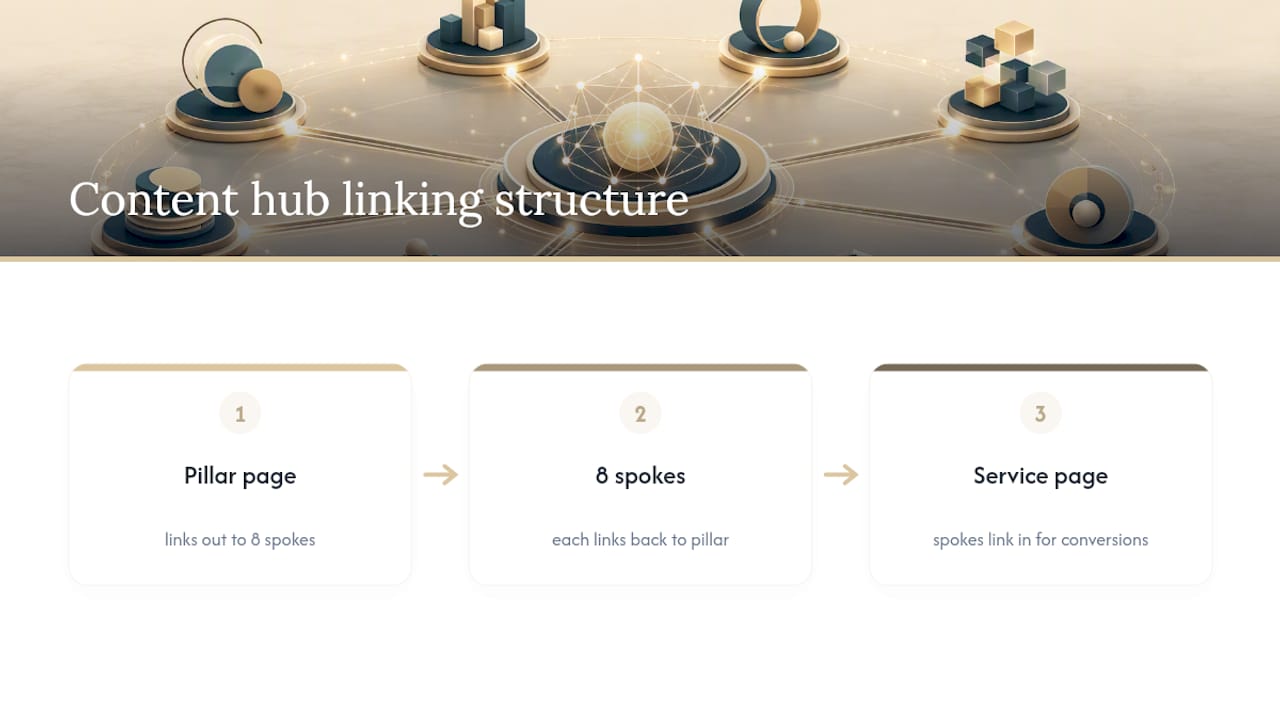
Structured clusters outrank isolated pages, and the gap shows up fast. Agency-collected data cited by Empirium found that spokes published inside a well-linked cluster reach ranking positions faster, and settle higher, than comparable pages published as standalone content. The difference isn’t the writing quality. It’s the linking.
The user-experience case is just as strong. A reader who lands on one spoke and immediately sees three related articles and a pillar overview stays on your site longer and visits more pages per session. That extra depth matters for AI Overviews and chat-based answer engines too, which tend to pull from sites that demonstrate topical range rather than a single lucky ranking page. Commercially, a hub also gives you more entry points into your funnel: every spoke is another query you can capture, and a well-placed link from a spoke into a service page gives your revenue pages organic support they’d never get standing alone.
How Should You Structure URLs, Navigation, and Schema for a Hub?
Architecture decisions made in week one either help or hurt every spoke you publish afterward. Get the folder structure wrong and you’ll be doing painful redirects a year in.
URL patterns: Nest spokes under the pillar’s path when your CMS allows it (/content-hub-strategy/measuring-cluster-kpis/ rather than a flat /blog/measuring-cluster-kpis/). This isn’t mandatory for rankings, but it makes the hub relationship legible to both crawlers and readers scanning a URL in search results.
Navigation placement that actually gets used:
- Add the pillar to primary site navigation if the topic is core to your business, not buried three clicks deep.
- Use a persistent “Explore this topic” or jump-link block on every spoke, pointing back to the pillar and to two or three sibling spokes.
- Add breadcrumbs (Home > Content Hub > Spoke Title) so both users and crawlers understand hierarchy at a glance.
- Keep a visible, updated list of all published spokes on the pillar page itself. Do not let it go stale.
Schema and on-page signals: Use BreadcrumbList schema to reinforce the hierarchy, and consider Article schema with consistent about entities across spokes so search engines can connect the dots between pages even without perfect linking. None of this replaces good internal links. It supports them.
How Do You Plan and Build a Content Hub Step by Step?
Building a hub in the wrong order is the single most common reason they underperform. Teams write the pillar first, publish it, then scramble to backfill spokes over the following year, by which point the pillar is stale and half the spokes cannibalize each other’s keywords.
- Score candidate topics before committing. Rate each potential hub on search volume, competition, commercial relevance, and content gap, the same way The Seo Engine’s portfolio framework recommends treating a hub roster like an investment portfolio. Don’t build a hub around a topic just because someone in a meeting liked it.
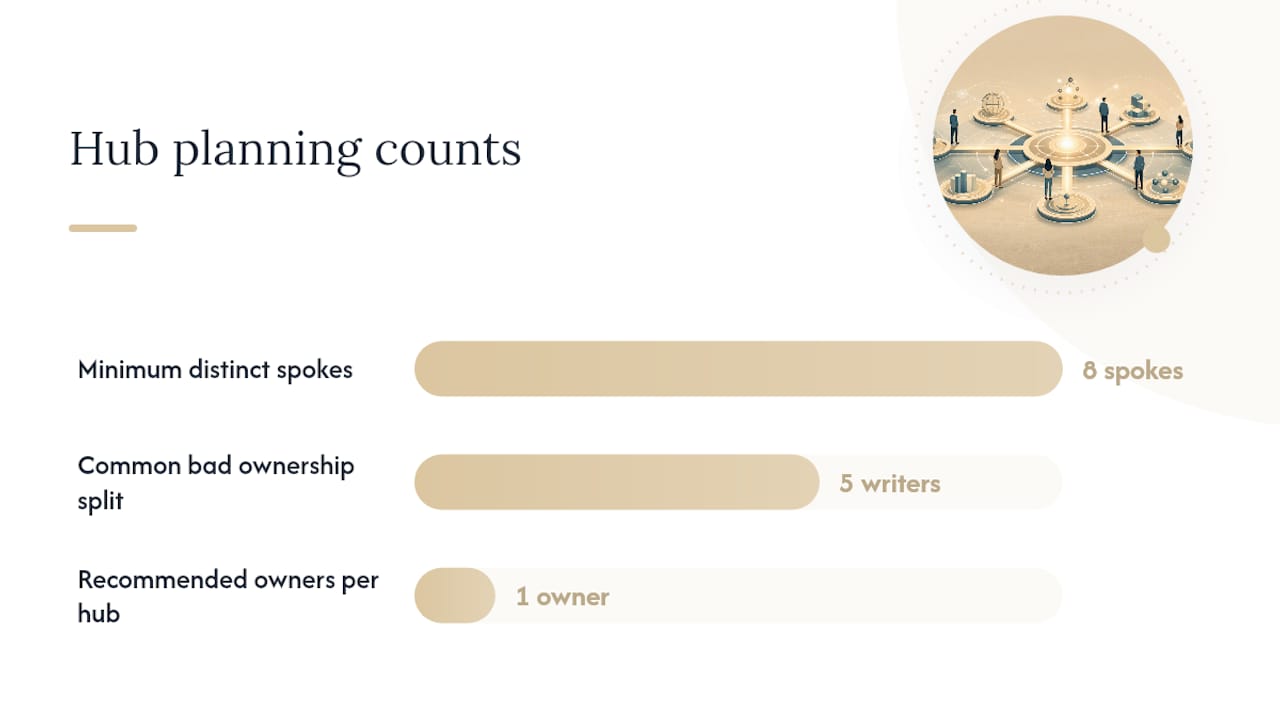
- Confirm the topic has enough depth. If you can’t identify at least eight genuinely distinct subtopics, each with its own search intent, the topic is probably too narrow for a hub and better served by a single strong page.
- Audit existing content first. Map every relevant page you already own to a future spoke slot before writing anything new. This single step, emphasized in Genpact’s hub-building guide, is what prevents duplicate content and wasted writing hours.
- Build the keyword-to-page map. One row per spoke: target keyword, search intent, existing page (if any), and priority score. A keyword mapping template keeps this from living in someone’s head.
- Validate subtopics with topic modeling. Tools like MarketMuse or Frase can flag where two planned spokes actually target the same intent, a mistake that’s expensive to fix after publishing, per Inbounder Learn’s clustering guidance.
- Publish three or four spokes before finishing the pillar. Early spokes can start ranking on their own and often reveal what the pillar actually needs to summarize, a sequencing tip worth taking seriously rather than writing the pillar in a vacuum first.
- Draft, link, and publish the pillar last, once you can see the real shape of the cluster.
Pro Tip: Write pillar page copy in a shared doc with a column for “spokes this section should link to.” It forces you to plan the internal links before publication instead of retrofitting them later, which is when they usually get skipped.
Assign one owner per hub, not per article. Split ownership across five different writers with no single point of accountability, and cadence slips within a month.
Which Internal Linking Patterns Actually Move Rankings?
Internal links are the mechanism, not a nice-to-have add-on. Without them, a pillar and its spokes are just eight unrelated pages that happen to share a topic in your CMS.
- Link from every spoke back to the pillar, and from the pillar to every spoke, ideally within the first 300 words of each page rather than buried in a footer, since links placed early carry more weight with both readers and crawlers.
- Cross-link related spokes to each other, not just up to the pillar. A spoke on “cluster KPIs” should link sideways to a spoke on “content audits,” not only upward.
- Vary anchor text across links to the same page. Don’t repeat “content hub strategy” as anchor text five times; rotate between “building a topic cluster,” “the pillar-and-spoke model,” and the page’s actual title, following the anchor-text diversity guidance in Search Engine Land’s topic clusters guide.
- Audit your link map quarterly with a crawler (Screaming Frog or Sitebulb both work) to catch orphan pages, spokes with only one inbound link, or pillar links that got dropped during a redesign.
Pro Tip: Run an “inbound link count” report for every spoke once a quarter. Any spoke with fewer than two internal links pointing to it is functionally invisible to both users and crawlers, even if the content is good. For a deeper breakdown of anchor-text patterns and audit workflows, see this internal linking strategy guide.
What Belongs on a Content Calendar for Scaling a Hub?
A hub calendar needs more structure than a general blog calendar because every entry has to slot into a linking plan, not just a publish date.
Track these fields at minimum for every planned spoke:
- Publish date and content owner
- Primary target keyword and search intent
- Internal link target (which pillar section, which sibling spokes)
- Content format (how-to, FAQ roundup, data piece, video companion)
- Review/refresh date, set 90 days out from publish
For launch, aim for a minimum viable hub of one pillar and five to eight spokes before you call the hub “live.” Fewer than that and you don’t have enough topical depth to signal authority. Once live, a steady cadence of one to two new spokes a month keeps the cluster growing without straining an editorial team. Mix formats deliberately: a data-driven spoke earns links and shares, an FAQ-style spoke captures snippet-style queries, and a short video or embedded tool extends time on page. Reuse strongly performing spokes as the basis for adjacent hubs rather than starting every new cluster from a blank page.
How Do You Measure and Report on Cluster Performance?
Judging a hub by any single page’s traffic misses the point entirely. The cluster is the unit of measurement, not the individual spoke.
Track these at the cluster level:
- Total cluster sessions (pillar plus every spoke, summed), to see whether the cluster is growing as a system.
- Average cluster position across all target keywords, which shows whether the cluster is gaining authority even before individual pages hit page one.
- Internal click-through rate from spoke to pillar and pillar to spoke, which tells you whether your linking is actually being used or just technically present.
- Cluster-attributed conversions, tracked separately from single-page conversion rates.
Run a 90-day review after any hub launch or major expansion. Pull Google Search Console data filtered to the cluster’s URLs, check for indexing gaps (pages that never got crawled), flag pages with impressions but near-zero clicks for title and meta rewrites, and identify any spoke sitting on page two that a single added internal link might push forward. A monthly SEO reporting template built around cluster grouping, rather than page-by-page rows, makes this review far faster than digging through GSC manually every time.
If your cluster tops out at four or five spokes, expect flatter growth curves than the model promises until you fill in the gaps.
When Is a Hub Worth Building, and When Should You Pause One?
Not every topic deserves a hub, and not every team has the capacity to run one well. A mismatch between ambition and resourcing is the most common reason hubs stall halfway.
- Confirm you can commit to at least eight spokes. If your keyword research surfaces only four or five genuinely distinct subtopics, build one strong standalone page instead. A thin hub looks worse to search engines than an honest single article.
- Check publishing discipline before you start, not after. A hub that manages one spoke every two months will take over a year to reach minimum viable size, and momentum dies long before then.
- Confirm you have an owner, a keyword map, and a linking plan drafted before writing begins. Skipping any of these three is the fastest route to orphan pages and keyword cannibalization.
- Watch for pause signals once live: flat or declining cluster sessions over two consecutive 90-day reviews, spokes cannibalizing each other in search results, or an inability to sustain the publishing cadence you committed to.
- If a hub stalls, reallocate rather than abandon. Redirect the writing capacity toward finishing an existing hub’s minimum viable spoke count instead of starting a second, thinner cluster.
How Proxiumdigital Approaches Content Hub Builds
Most hub failures aren’t content failures. They’re architecture failures baked in before a single article gets written, because the site’s navigation, CMS structure, or URL scheme was never designed to support a cluster in the first place. Proxiumdigital builds SEO into the site architecture from day one rather than layering a content plan onto a template that fights it, which is the gap between agencies that hand off a keyword list and ones that actually own the build.
A hub that launches on a site built with the linking structure planned in advance avoids the single most common failure mode: orphan spokes that never get indexed because nothing links to them yet. Planning the folder structure, navigation, and internal link map before the first spoke is written is what prevents that.
How Does a Content Hub Fit Into Your Broader Content Strategy?
A hub is not a side project you bolt onto your existing blog calendar. It’s an implementation layer for whatever business goals your content marketing strategy already claims to serve, whether that’s lead generation, brand authority, or support-cost reduction through better self-serve documentation.
The connection has to run both directions. Your hub topics should come out of the same business-value scoring you’d use for any content investment: which subjects, if you owned the top rankings, would actually move revenue or reduce customer acquisition cost. And your hub’s internal links should terminate somewhere useful, not just in more content. A spoke about “keyword mapping” that never links to your SEO service page is leaving conversion opportunity on the table; a service page SEO guide covers exactly how that connective tissue between informational content and commercial pages should work.
Treat your content hub roster the way you’d treat a product portfolio: a handful of hubs, each scored and prioritized, rather than a sprawling blog with no organizing structure. Teams that try to run five or six hubs simultaneously with a two-person content team almost always end up with five or six half-finished clusters instead of two or three that actually rank. Better to finish fewer hubs completely than to start many and abandon most of them at spoke number three.
How Do Audience Personas Shape a Content Hub?
The subtopics you choose for a hub, and the order you publish them in, should come directly from who you’re actually trying to reach, not from whatever keywords have the highest search volume in a tool.
A hub aimed at first-time buyers needs foundational spokes (definitions, comparisons, “how does this work” pieces) published early, because that audience is still forming their vocabulary for the topic. A hub aimed at experienced practitioners can skip straight to advanced tactics and skip the 101-level content entirely, or relegate it to a single glossary-style spoke rather than several full articles.
Personas also dictate anchor-text and navigation choices. A B2B decision-maker persona responds to spokes that link toward ROI and measurement content; a DIY-oriented persona responds better to spokes that link toward step-by-step how-to content. If your hub currently serves two very different personas with the same linking pattern, you’re probably underserving one of them.
Run persona checks against your keyword map before building, not after: for each planned spoke, ask which persona searches that exact phrase and what they’d want to click next. If two spokes serve the same persona at the same stage of awareness, you likely have redundant content rather than genuine cluster depth. If your keyword map has gaps where a persona’s obvious next question has no corresponding spoke, that’s your next content brief, not a nice-to-have for later.
What Do Successful Content Hubs Look Like Across Industries?
The pillar-and-spoke model looks different depending on the business behind it, but the linking discipline stays constant.
A local professional services firm, a law practice or accounting firm, for instance, might build a hub around “small business tax planning” with spokes covering quarterly estimates, entity structure choices, and deduction categories, each spoke linking back to a pillar that also links directly into a consultation booking page. The commercial tie-in matters as much as the topical coverage; a hub that never links toward a service page is leaving its own traffic on the table.
A SaaS company selling project management software might build a hub around “remote team collaboration,” with spokes on async communication, time zone scheduling, and meeting cadence, each one naturally referencing the product without turning every spoke into a sales pitch.
A healthcare practice might build a hub around a specific condition or treatment area, with spokes addressing symptoms, treatment options, and recovery timelines, all linking back to a pillar that also connects to appointment scheduling.
What ties these together isn’t the industry. It’s that each hub picked a topic with enough genuine subtopic depth to justify eight-plus spokes, mapped those spokes to real search intent rather than guessing, and built the linking structure before publishing rather than retrofitting it. Skip any of those three steps and the industry stops mattering; the hub underperforms regardless of the vertical.
Which Tools Help You Manage a Content Hub at Scale?
Running a hub with a spreadsheet works for the first five spokes. It stops working around spoke number ten, when tracking link relationships, review dates, and keyword overlaps by hand becomes its own part-time job.
For topic research and cannibalization checks, NLP-based tools like MarketMuse or Frase help confirm that two planned spokes don’t actually target the same search intent before you’ve spent a week writing both. For technical link auditing, a crawler like Screaming Frog or Sitebulb will surface orphan pages, broken internal links, and spokes with too few inbound links faster than manual review ever will.
For the editorial and workflow side, a structured content calendar, whether in Airtable, Notion, or a dedicated CMS module, needs to track the fields already outlined: owner, keyword, intent, link targets, and review date. The specific tool matters less than whether every stakeholder actually uses the same one; a hub tracked half in Notion and half in someone’s personal spreadsheet loses its map within a month.
For measurement, Google Search Console remains the primary source for cluster-level indexing and position data, paired with your analytics platform for session and conversion tracking. None of these tools substitute for the planning work. They just make the planning work visible and repeatable across a team larger than one person.
How Do You Promote a Content Hub After It’s Published?
Promotion for a hub works differently than promotion for a single article, because you’re not trying to get one page to go viral. You’re trying to build sustained authority signals across a whole cluster.
Internal promotion matters more than most teams assume. Every new spoke should get referenced in your email newsletter and linked from relevant service pages, not just dropped into a blog feed and forgotten. Update the pillar page itself every time a new spoke publishes; a stale pillar page signals to both readers and search engines that the cluster stopped growing.
External promotion should target link-worthy spokes specifically, usually the data-driven or original-research pieces, rather than trying to earn backlinks to every single page in the cluster equally. Pitch those pieces to industry newsletters or partner sites through the same outreach process you’d use for any standalone content asset; the difference is that a link earned to one spoke lifts the whole cluster through your internal linking structure, not just that one page.
Social promotion works best when it points readers into the hub’s entry point (the pillar) rather than scattering links to individual spokes across different posts, since that consolidates whatever traffic and engagement you generate into a single, trackable landing point that then distributes readers onward through your internal links.
Who Should Own Editorial Governance for a Content Hub?
A hub without a single accountable editor drifts fast: tone shifts between spokes, outdated statistics sit unfixed for a year, and internal links quietly break as pages get updated independently.
Assign one editorial owner per hub, not per article, someone responsible for consistency across every spoke, not just their own assigned pieces. That person maintains a standing style reference for the hub (terminology choices, tone, formatting conventions) so a hub built by three different writers over a year still reads as one coherent resource.
Build a lightweight review cadence into governance, not just into your content calendar. Every spoke gets a scheduled 90 day check for accuracy and link health, and the pillar itself gets reviewed whenever a new spoke publishes, since that’s the moment its summary section needs updating. Skipping this step is how pillar pages end up referencing “our five spokes on this topic” a year after the eighth one published.
Version control matters more for hubs than for standalone content because changes ripple. If you update a spoke’s target keyword or restructure its headings, someone needs to check whether that breaks the anchor text or context of links pointing to it from elsewhere in the cluster. A simple shared log of what changed, when, and why prevents most of the drift that makes older hubs feel disjointed compared to their newer spokes.
When Is a Content Hub Strategy Actually Worth the Investment?
Build a hub when a topic has real business value and genuine depth, at least eight distinct angles worth writing about, and skip it when you’re really just trying to justify eight blog posts about the same idea. The honest test: could a competitor’s single strong article outrank your planned pillar? If yes, you don’t have hub-worthy depth yet.
For a fast diagnostic, spend the next seven days auditing three high-value candidate spokes: check whether pages already exist, whether the keyword targets overlap, and whether an internal link plan is even feasible on your current site structure. Expect a real hub, from that audit through a minimum viable launch, to take two to four months for a small team. Rushing it produces exactly the thin, half-linked clusters this whole framework exists to prevent.
— Bryan
Build the Hub Right the First Time With Proxiumdigital
A DIY content calendar and a freelance writer roster can get you spokes. What most teams can’t easily DIY is the site architecture underneath them: the URL structure, navigation, and internal link scaffolding that determines whether those spokes ever get indexed and linked correctly in the first place. Proxiumdigital builds that architecture into the site from the start, rather than treating SEO as a layer applied after the design is already locked, which is the gap that causes most orphan pages and cannibalized rankings in hubs built on templates that were never designed for clustering.

If you’re planning a hub and want the underlying site structure and SEO strategy built together rather than handed off between two vendors, Proxiumdigital’s SEO and web design services cover the strategy, the technical build, and the ongoing management once the cluster is live. Teams that already have a site but need the internal linking, keyword mapping, and cluster measurement handled can start with the SEO optimization service directly. Check current pricing for Metro Detroit businesses and book a discovery call to map your first three candidate spokes before you write anything.
Sources
- Topic clusters and hub-and-spoke guidance | HubSpot Blog
- Topic clusters guide | Search Engine Land
- How to build a content hub, step-by-step | Genpact
- Content hub strategy: the architecture that wins SERPs | Empirium
FAQ
What Are the 5 Pillars of Content Strategy?
Definitions vary across practitioners, but a common version includes audience research, content planning and mapping, creation and governance standards, distribution and promotion, and measurement against business goals. A content hub strategy is essentially the structural implementation of the planning and measurement pillars applied to a single topic.
Can You Give Examples of Content Hubs?
A professional services firm might build a hub around a specific practice area with spokes covering common client questions, each linking back to a consultation page; a SaaS company might build one around a core use case with spokes on adjacent workflows. The common thread across industries is a pillar page linking to at least five to eight spokes, with links running in both directions.
What Is the 70/20/10 Rule in Content Marketing?
Applied to a content hub strategy, that often means most spokes cover well-validated subtopics while a smaller share test new angles or formats like video or interactive tools.
What Are Examples of Content Strategies?
Common strategies include pillar-and-spoke content hubs, pure SEO-driven keyword targeting, thought-leadership publishing, and customer-education libraries built around product use cases. A content hub strategy specifically organizes content around topical clusters rather than one-off pieces, which is what makes it effective for compounding organic visibility over time rather than chasing individual keyword wins.
How Many Spokes Does a Content Hub Need to Work?
Most practitioner frameworks recommend a minimum of five to eight spokes per pillar to demonstrate real topical depth, with eight often cited as the threshold where clusters reliably outperform standalone pages. Fewer than that, and the cluster typically lacks the breadth needed to signal authority to search engines.